The Convergence of Time, Geography, and Divinity
Ujjain, historically known as Avanti, stands as a profound testament to the intersection of human civilization, cosmological science, and metaphysical philosophy on the Indian subcontinent. Situated on the eastern banks of the sacred Kshipra River in the Malwa plateau of modern-day Madhya Pradesh, this ancient metropolis represents far more than a mere geographical locus; it is the spiritual and temporal navel of the Hindu cosmos. Recognized as one of the Sapta Puris—the seven sacred cities (Ayodhya, Mathura, Maya, Kashi, Kanchi, Avantika, and Dwaravati) believed to bestow Moksha (spiritual liberation)—Ujjain has maintained an unbroken continuity of cultural and religious significance for over five millennia. The Varaha Purana goes as far as to describe Avantika structurally as the absolute navel region of the metaphorical body of all holy places, an assertion that places it at the center of ancient spiritual geography.
The city’s preeminence is not solely derived from its mythological associations but is deeply anchored in ancient archaeoastronomy. For millennia, Ujjain functioned as the “Greenwich of India,” the universally acknowledged prime meridian for ancient Vedic timekeeping and astronomical calculations. This duality—serving as the absolute center for calculating physical time while simultaneously being the terrestrial abode of Lord Mahakala, the conqueror of time and death—creates a unique conceptual framework. Ujjain is the threshold where the quantifiable dimensions of planetary motion dissolve into the infinite, non-dual reality of spiritual liberation. The city’s landscape, punctuated by revered Jyotirlingas, ancient observatories, esoteric caves, and sacred groves, forms an intricate architectural mandala that has attracted scholars, kings, ascetics, and divine avatars across successive yugas.
Nomenclature and the Puranic Genesis of Avanti
The historical depth of Ujjain is reflected in the multitude of names it has borne across different cosmic epochs, each capturing a specific facet of its spiritual, ecological, and political grandeur. According to the Adi Brahma Purana, it is described as the best of all cities, while the Agni Purana and Garuda Purana laud it as the ultimate source of both worldly enjoyment (bhukti) and eternal salvation (mukti). Furthermore, esoteric traditions claim the city has never faced absolute destruction, as it is perpetually guarded by the ultimate destroyer of illusions, Lord Mahakal himself.
The name “Ujjain” itself is derived from the Sanskrit word Ujjayini, which translates to “one who conquers with pride” or simply “victory”. This name was originally bestowed upon the city to commemorate Lord Shiva’s fierce triumph over the demon Tripurasura at this exact geographical location, an event explicitly detailed in the Avantyakhand of the Skanda Purana.
The various ancient appellations of the city highlight its multidimensional significance across scriptural literature:
| Ancient Name | Etymological Meaning and Scriptural Context |
| Avanti / Avantika | Denotes the capital of the Avanti Janpada; a city that protects and sustains its inhabitants. It is the primary name associated with the region’s political dominance during the Mahajanapada era, signifying a realm of continuous prosperity. |
| Kushasthali | An early name linked to the city’s genesis. The Skanda Purana notes that the sage Kaśyapa (son of Marīci) performed severe penance here for a thousand years, subsisting only on withered leaves and air, to beget divine progeny. |
| Amaravati | Translates to the “City of Immortals.” Following Kaśyapa’s penance, an unembodied goddess declared that Devas, including Vishnu and Indra, would become his sons. They subsequently made this city their permanent residence, endowing it with the amenities of heaven. |
| Vishala | Meaning “The Vast One.” This title was famously utilized by the great classical poet Kalidasa to describe the expansive, cosmopolitan (Sarvabhauma) nature of the metropolis, which spread over a massive geographical area. |
| Kumudvati | Named after the yellow night-blooming water lily. This title highlights the city’s aesthetic beauty, grace, and romantic allure as continuously depicted in classical Sanskrit poetry and soliloquy. |
| Kanakasrnga | Translates to “The Golden Peak,” indicating the city’s immense terrestrial wealth, spiritual luminosity, and the presence of soaring golden spires on its ancient temple architecture. |
| Mahakalpuri | The “City of Mahakal,” indicating its paramount status as the exclusive, eternal domain of Lord Shiva in his fearsome form as the master of time and mortality. |
These names functioned as historical markers that codified the city’s evolution through time. When Emperor Vikramaditya established his capital here, the city temporarily became known as Vikrampuri, reflecting the shifting dynamics between divine mythology and absolute human sovereignty. Through all these variations, the underlying theme remains one of cosmic centrality and spiritual fertility.
The Cosmic Navel: Archaeoastronomy and the Prime Meridian
The scientific legacy of Ujjain is arguably unparalleled in ancient history, seamlessly blending empirical astronomy with metaphysical geography. While modern geography utilizes the Greenwich meridian as the zero-degree longitude, classical Indian astronomy positioned its prime meridian directly through Ujjain. The city was universally acknowledged as the “crossroad of Space and Time,” providing the foundational baseline for all geographical, navigational, and astrological calculations in the ancient world. International awareness of this was profound; even Greek geographers like Ptolemy explicitly included “Ozine” (Ujjain) and its zero meridian in their global maps.
This designation is not a mere cultural claim but a mathematically rigorous tradition codified in foundational texts. The Surya Siddhanta, an ancient Hindu treatise on astronomy dating to the 4th-5th century CE, explicitly states in Chapter I, Shloka 62, that Rohitaka (modern-day Rohtak), Avantika (Ujjain), Kurukshetra, and Lanka lie perfectly on the longitudinal meridian stretching from the equator to the North Pole. This line was designated as the absolute “middle line of the earth”. The text provides highly precise instructions for converting local time across the entire subcontinent into standard Ujjain time, a system that allowed ancient Indian astronomers to grasp the concept of time zones and global geography centuries before their Western counterparts.
The Tropic of Cancer and Planetary Alignments
Ujjain’s astronomical preeminence was further cemented by its latitudinal positioning. Geographically, ancient Ujjain was believed to sit at the exact intersection of the prime meridian (zero longitude) and the Tropic of Cancer. Tradition specifies that this cosmic intersection passed directly through the Karkoteshwar temple (located within the Harsiddhi Temple compound) and the Mangalnath Temple.
The Matsya Purana identifies the Mangalnath Temple, perched on an elevated hill overlooking the Kshipra River, as the actual terrestrial birthplace of the planet Mars (Mangala). Because of this profound planetary connection, Mangalnath remains a highly active center for astronomical studies and specialized rituals, particularly the Mangal Bhaat Pooja and Mangal Grah Shanti Jaap, which are performed by devotees seeking to pacify severe planetary afflictions and achieve cosmic balance. The distance from the Mahakaleshwar temple to Mangalnath is roughly six to seven kilometers, creating an axis of spiritual and astronomical power within the city.
A critical insight into Ujjain’s archaeoastronomy lies in the sophisticated understanding of the Earth’s axial obliquity. While the Tropic of Cancer does not perfectly cross the exact site of the Karkoteshwar temple in the contemporary era, modern astrophysics confirms that the Earth’s axial tilt oscillates between 22.1 and 24.5 degrees over a vast 41,000-year cycle. Calculations reveal that the Tropic of Cancer last crossed the precise ancient coordinates of Ujjain approximately 20,000 years ago. This geological reality suggests that the astronomical texts defining Ujjain’s sacred geography may contain the remnants of profound observational data spanning tens of thousands of years, preserving a deep-time memory of planetary mechanics that predate modern civilization.
Jantar Mantar and the Legacy of Mathematical Astronomy
The atmosphere of rigorous scientific inquiry in Ujjain attracted the most brilliant minds of ancient India, making it the veritable cradle of Hindu mathematical astronomy. The city’s astronomical observatory functioned as the principal seat of learning for luminaries such as Aryabhata (476 CE), Varahamihira (6th century), and Brahmagupta (7th century). Under their stewardship, precise orbital parameters for the planets were recorded, and the Earth’s diameter was calculated at 8,000 miles—a figure astonishingly close to the modern scientific measurement of 7,928 miles.
During the 12th century, the Ujjain observatory was headed by Bhaskara II (1114–1185 CE), who represented the absolute zenith of mathematical knowledge of his era. In his monumental treatise, the Siddhanta Shiromani (written in 1150 CE), Bhaskara II explicitly utilized the Ujjain prime meridian as his absolute baseline to calculate planetary mean and true longitudes, predict solar and lunar eclipses, develop complex spherical trigonometry, and even outline early conceptual frameworks for Earth’s gravity.
This profound scientific heritage was honored and physically revitalized in the early 18th century by Maharaja Jai Singh II of Jaipur. After sending his scholars across several countries to study contemporary observational technologies and manuals, Jai Singh constructed five massive astronomical observatories, known as Jantar Mantar, between 1724 and 1737. Recognizing Ujjain’s historical status as the unbroken meridian of Hindu astronomy, he built an observatory there in 1725 at an elevation of 75.6 meters. The Ujjain Jantar Mantar, which remains functionally operational today, features massive masonry instruments designed to measure planetary and solar movements without the use of optical telescopes, serving as a tangible, enduring bridge between ancient cosmological theory and early modern observational science.
The Mythological Matrix: Samudra Manthan and the Simhastha Kumbh
The spiritual gravity of Ujjain is inextricably linked to one of the most foundational, dynamic narratives in Hindu cosmology: the Samudra Manthan, or the Churning of the Milky Ocean. This mythological event not only explains the origin of the cosmos’s most precious artifacts but also strictly dictates the grand ritual calendar of the city.
The Churning of the Milky Ocean
The origins of the Samudra Manthan lie in a catastrophic curse. According to puranic texts, the tempestuous and irascible sage Durvasa offered a divine garland—said to be blessed by Lakshmi, the goddess of fortune—to Indra, the king of the Devas. Indra carelessly placed the garland on his elephant mount, Airavata, who immediately tossed the sacred object to the ground when swarmed by bees. Enraged by this arrogant disrespect, Durvasa cursed Indra and all the Devas, causing them to completely lose their divine strength, sovereignty, and immortality.
To regain their power, the severely weakened Gods were instructed by Vishnu to form an uneasy, desperate alliance with the Danavas (demons) to churn the Kshir Sagar (Ocean of Milk) in pursuit of the Amrut Kumbh—the magical pot containing the nectar of immortality. When the Kumbh finally emerged from the chaotic cosmic waters alongside precious gems, a fierce, desperate struggle ensued. To prevent the demons from consuming the nectar and gaining eternal dominance, the Devas seized the pot and fled. In various retellings of the myth, the carrier of the pot is identified as Mohini (the enchanting female avatar of Vishnu), Dhanvantari (the god of Ayurveda), Garuda (Vishnu’s eagle mount), or Jayanta (the son of Indra).
During a celestial chase that lasted twelve divine days—equating to twelve human years—the carrier of the nectar rested at four specific locations on Earth. During these resting periods, drops of the immortal nectar spilled from the Kumbh onto Prayagraj, Haridwar, Nashik, and Ujjain.
The Simhastha Kumbh Parva
Because the nectar fell directly into the waters of the Kshipra River at Ujjain, the river itself was permanently transformed into a vessel of immortality. To commemorate this cosmic event, the Kumbh Mela is held in a strict rotation across these four cities. In Ujjain, the festival is specifically known as the Simhastha Kumbh Mahaparv, which occurs once every twelve years based on highly specific astrological alignments—primarily when the planet Jupiter enters the zodiac sign of Leo (Simha).
The Simhastha Kumbh Mela is celebrated as the largest spiritual gathering on planet Earth. Millions of ascetics, representing thousands of distinct akhadas (monastic orders), alongside lay pilgrims, converge on the Ram Ghat and other sacred banks of the Kshipra. A ceremonial bath during the astrologically favorable moments of the Kumbh is believed to rapidly cleanse the soul of accumulated karmic debt and grant direct access to Moksha, as the river temporarily regains its nectar-infused properties.
The academic perspective provides a nuanced overlay to this profound religious reality. Modern historical scholarship, led by researchers such as R. B. Bhattacharya, D. P. Dubey, and Kama Maclean, points out that while ancient Puranas extensively detail the Samudra Manthan, the earliest texts do not explicitly mention the spilling of nectar at these four specific sites or the Kumbh Mela itself. Scholars suggest that the mythological legend was masterfully synthesized and applied to the existing river festivals relatively recently in historical terms, serving to consolidate scriptural authority and unify disparate regional traditions into a singular, pan-Indian spiritual phenomenon. Regardless of the timeline of its textual codification, the psychological and spiritual reality of the Kumbh Mela remains an undeniable, overwhelming force in the Indian religious landscape.
Mahakaleshwar Jyotirlinga: The Sovereign of Time and Death
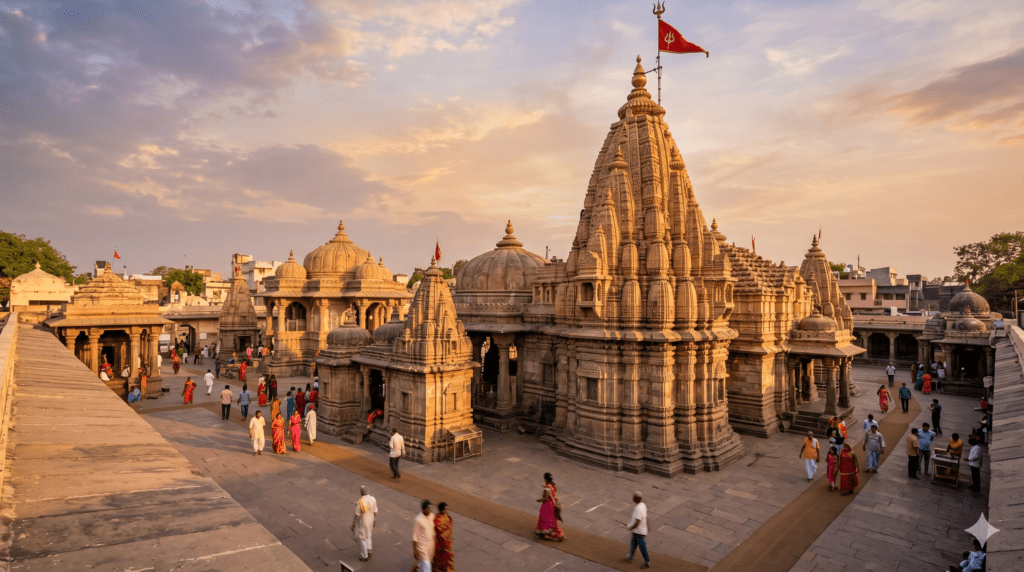
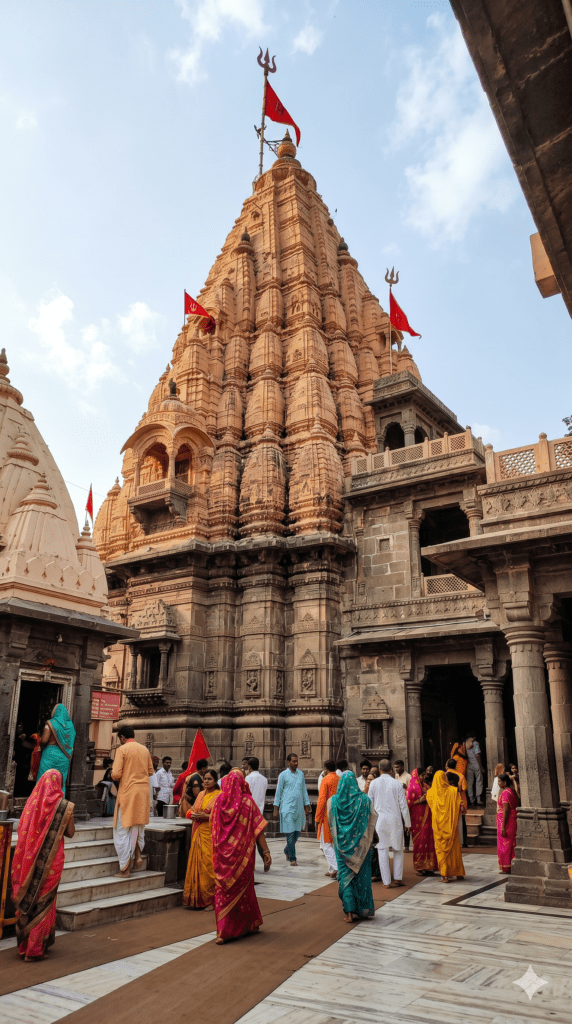
At the absolute epicenter of Ujjain’s sprawling spiritual topography is the Mahakaleshwar Jyotirlinga. Among the twelve sacred Jyotirlingas—where Lord Shiva is worshipped as an infinite, blazing pillar of radiant light—Mahakaleshwar commands unparalleled, terrified reverence. The deity is not merely viewed as a manifestation of the divine; to the inhabitants of Ujjain, Lord Mahakal is the literal, eternal sovereign of the city. A profound local tradition, strictly adhered to even today, holds that no earthly authority, be it a King, Prime Minister, or President, is permitted to stay overnight within the city limits, as Ujjain can host only one true ruler: Mahakal.
Mythological Origins and Historical Trials
The dramatic manifestation of the Mahakaleshwar Jyotirlinga is detailed in the Shiva Purana. In ancient times, Avanti was ruled by a highly devoted king named Chandrasena, a sincere worshipper of Lord Shiva. A young cowherd named Shrikhar, passionately desiring to worship Shiva alongside the king, was forcefully removed from the royal rituals. Retreating to the outskirts of the city, Shrikhar overheard a sinister conspiracy by rival kings, Ripudamana and Singhaditya, who had allied with a fearsome, destructive demon named Dushanan to annihilate Ujjain and eradicate its Vedic culture.
As the invading army viciously assaulted the city, Shrikhar and a local priest named Vridhi engaged in desperate, intense prayer. Answering their pure devotion, Lord Shiva shattered the earth and emerged in his most terrifying, magnificent form—Mahakal. Blazing with the violent energy of a thousand suns, he instantly incinerated the demonic forces. At the pleading of his overwhelmed devotees, Shiva agreed to permanently reside in Ujjain as a Swayambhu (self-manifested) Jyotirlinga, vibrating with natural cosmic energy rather than being ritually installed by human hands.
The physical temple complex housing the deity has endured a deeply tumultuous history that mirrors the political upheaval of the subcontinent. While the Puranas credit Prajapati Brahma with the initial construction of the shrine, the temple suffered catastrophic destruction during the medieval period. In 1234–1235 CE, the Delhi Sultanate ruler Iltutmish violently sacked Ujjain, completely dismantling the Jyotirlinga and casting it into the adjacent Koti Teerth Kunda pond, plunging the region into centuries of spiritual disruption. The temple faced further desecration by subsequent invaders, including Jalaluddin and Alauddin Khalji.
However, the resilience of Ujjain’s spiritual culture ultimately prevailed. In 1734 CE, during the ascendancy of the Maratha Empire, the temple was magnificently resurrected. Under the direct command of Ranoji Shinde, a general to Peshwa Baji Rao I, and guided by Pandit Narayan Dikshit and Prime Minister Baba Ramchandra Suktankar, the current multi-tiered stone structure was erected. This massive reconstruction initiated a cultural reclamation of the Mahakalvan, establishing the modern three-level architecture seen today: the underground level housing the Mahakaleshwar Shivalinga, the second level featuring the Omkareshwar Lingam, and the third level containing the Nagchandreshwar shrine, which opens only once a year on Nag Panchami.
The Dakshinamukhi Orientation and Esoteric Significance
What dramatically distinguishes Mahakaleshwar from all other Jyotirlingas is its architectural and spiritual orientation. It is the only Jyotirlinga in the world that is Dakshinamukhi, meaning it deliberately faces the south.
In traditional Hindu cosmology, the southern direction is governed by Yama, the lord of death, and is considered highly inauspicious. By deliberately facing this direction, Lord Shiva asserts his ultimate, supreme dominion over death itself. The name “Mahakal” is a synthesis of Maha (Great) and Kaal (Time/Death). The south-facing orientation acts as an esoteric shield; it signifies that Mahakal absorbs and neutralizes the destructive energies of time, protecting his devotees from untimely death (Apamrityu) and eradicating the primal fear of mortality. Worshiping at this shrine is believed to burn away the accumulated karmic attachments of the soul, effectively breaking the samsaric cycle of endless birth and death to grant true Moksha.
The Bhasma Aarti: Awakening Eternal Consciousness
The most profound expression of Mahakaleshwar’s philosophy is witnessed in the daily Bhasma Aarti, an ancient, transformative ritual performed at 4:00 AM before dawn. Mahakaleshwar is the only Shivalinga globally where this specific, intense rite occurs daily.
During the ceremony, the Shiva Lingam is vibrantly awakened with the extremely loud, rhythmic beating of damrus (hand drums), massive temple bells, and the chanting of “Om Namah Shivaya,” while the priests adorn the deity with sacred ash (Bhasma). Traditionally, this ash was gathered fresh from the local cremation grounds, serving as a stark, visceral visual representation of non-duality and the ultimate reality that all material life, no matter how grand, is temporary and will eventually be reduced to ash. Today, the ritual utilizes consecrated ash brought from the holy banks of the Shipra River.
As the Lingam is intricately decorated with a silver crown, serpent motifs, and precious jewels, the raining ash symbolizes the pure, eternal consciousness that remains after the physical ego has been completely burned away. For the thousands of devotees who gather to witness this, the Bhasma Aarti is not merely a visual spectacle but a deeply transformative spiritual initiation designed to shatter physical identification, remove fear, and instill a state of pure, detached awareness.
Sacred Geography: The Architectural Mandala of Ujjain’s Temples
While Mahakaleshwar serves as the undisputed anchor of the city, Ujjain is often colloquially described as the “City of Temples,” functioning as a sprawling, interconnected spiritual ecosystem. A popular local proverb suggests that if one were to offer a single handful of rice at every temple in Ujjain from two fully loaded cartloads, the rice would be exhausted, but there would still be temples left unvisited. The city’s geography operates as a vast mandala, featuring distinct power centers representing diverse, complimentary paths of Hindu spiritual practice.
| Sacred Site | Spiritual Significance and Historical Context |
| Harsiddhi Temple | One of the 51 supreme Shaktipeethas. It marks the exact spot where the elbow of the Goddess Sati fell after her self-immolation. Highly venerated by Emperor Vikramaditya, the temple radiates intense divine feminine energy. The current structure possesses a heavy Maratha architectural touch due to extensive restoration, uniquely featuring a dark red idol of Annapurna situated between Mahasaraswati and Mahalaxmi. |
| Kal Bhairav Temple | Dedicated to the fierce, protective manifestation of Shiva. Kal Bhairav serves as the Senapati (Commander-in-Chief) and absolute guardian deity of Ujjain. The temple is famous for its esoteric tantric roots, having been popular among the Kapalika and Aghora sects. It maintains the unique tradition where the deity physically accepts offerings of liquor. The deity’s silver head is adorned with a Maratha-style pagri, a tradition initiated by the legendary general Mahadaji Shinde. |
| Sandipani Ashram | Dating back over 5,000 years, this is the legendary site where Lord Krishna, his brother Balarama, and Sudama received their education from Maharishi Sandipani. The ashram houses the Gomti Kund, believed to have been created by Krishna, and a unique Shiva temple where Nandi stands upright before the deity. |
| Chintaman Ganesh | Houses a deeply revered Swayambhu (self-manifested) idol of Lord Ganesha. The deity is specifically worshipped for his power to eradicate worldly anxieties (“Chintaman” translates to reliever of worries) and bestow mental clarity and peace. |
| Gadkalika Mandir | An ancient shrine dedicated to Goddess Kalika, famously known as the deity who directly bestowed boundless literary and poetic genius upon the legendary Sanskrit poet Kalidasa. |
Educational Anchors: The Legacy of Sandipani Ashram
Ujjain’s spiritual authority is matched by its historical status as an educational nexus. Long before the great monastic universities of Nalanda and Taxila reached their zenith, Ujjain was a vibrant, unparalleled center of learning. The nucleus of this intellectual tradition was the Sandipani Ashram.
The ashram symbolizes the highest ideals of the ancient Vedic guru-shishya (teacher-student) tradition. The curriculum imparted to students like Krishna and Balarama was exhaustive, spanning the Vedas, Puranas, Upanishads, advanced mathematics, military science, statecraft, and the fine arts. The ashram grounds, open to seekers from 6:00 AM to 9:00 PM, still contain the ancient Peepal tree under which lessons were historically imparted, radiating deep serenity. The site remains a vibrant pilgrimage center for seekers of knowledge, heavily activated during festivals like Saraswati Puja and Guru Purnima. Furthermore, the presence of footprints believed to belong to Bhagwan Shri Krishna connects the academic history of the site directly to the divine.
The Ascetic Crucible: The Nath Sampradaya and the Caves of Awakening
Ujjain’s spiritual landscape is deeply marked by the ascetic traditions of the Nath Sampradaya, a highly esoteric and heterodox sect that emerged prominently in the 12th and 13th centuries. The Nath tradition uniquely combined philosophical and physical influences from Buddhism, Shaivism, Tantra, and Hatha Yoga. The founders of this tradition explicitly utilized the forests and caves of Ujjain to master dark, socially shunned practices, challenging all orthodox premises to achieve the sahaja siddha state—an awakened self’s direct identity with absolute reality.
The Shrine of Pir Matsyendranath, located on an elevated hill overlooking the Kshipra River close to the Gadkalika Temple, is the resting place of the legendary 9th or 10th-century saint Matsyendranath. Mythologized as having been born from the stomach of a fish (Matsya), he is revered as the originator and supreme founder of the Nath lineage, which was later systemized and propagated by his supreme disciple, Gorakhnath. The simple, serene tomb remains a highly active pilgrimage spot where devotees seek blessings for spiritual growth and physical healing.
A short distance away lie the Bhartrihari Caves, an intricate, slightly congested rock-hewn complex on the riverbanks. These caves served as the primary meditation retreat for the sage-poet Bhartrihari, historically the elder brother of Emperor Vikramaditya. After becoming completely disillusioned with the trappings of royal life and human attachments, Bhartrihari abdicated his throne, joined the Nath sect, and retreated to these extremely narrow, dark caves. According to Nath legend, he meditated here in absolute isolation for 12 years in the company of his nephew Gopichand, who had also renounced the world. Within these rock walls, Bhartrihari ultimately achieved profound spiritual realization, subsequently composing timeless, brilliant Sanskrit treatises on philosophy, wisdom, and renunciation that are still studied today.
Political Evolution: The Pradyota Dynasty to Emperor Vikramaditya
Beneath the heavy layers of puranic mythology lies the robust, extensively documented political history of Ujjain. The city was the heart of the Avanti kingdom, one of the sixteen Mahajanapadas (great realms) that dominated ancient India prior to the rise of the Mauryan Empire. The Aṅguttara Nikāya, a foundational Buddhist text, notes that Avanti was geographically divided by the river Vetravati (Betwa), with Mahishmati serving as the northern center and Ujjayini acting as the political and economic capital of the southern region.
The Pradyota Dynasty and the Age of Mahajanapadas
During the 6th century BCE, the political landscape of Avanti was violently transformed by the rise of the Pradyota dynasty. Founded by Chanda Pradyota, who ascended to supreme power after his father Pulika assassinated the previous King Ripunjaya to overthrow the Brihadratha dynasty at Ujjain, the new dynasty marked a crucial transition from tribal oligarchies to powerful, centralized, hereditary monarchies.
Chanda Pradyota was an ambitious, fearsome monarch, a direct contemporary of King Bimbisara of Magadha and King Udayana of Vatsa. The diplomatic relationship between Ujjain and Magadha was highly complex and deeply intertwined; historical records indicate that Bimbisara dispatched his legendary royal physician, Jivaka, to treat Pradyota when the Avanti king fell gravely ill, highlighting the sophisticated diplomatic interconnectedness of these ancient states.
This era was characterized by an unprecedented philosophical awakening across the subcontinent. Ujjain under the Pradyotas became a cosmopolitan hub that attracted merchants, ascetic monks, and scholars. Crucially, the dynasty’s reign overlapped with the lives of both Siddhartha Gautama (the Buddha) and Lord Mahavira (the 24th Jain Tirthankara). Both Buddhist and Jain records aggressively claim the patronage of King Pradyota. While Buddhist texts note his eventual psychological conversion from extreme cruelty to the dharma, Jain records detail his deep, active devotion to Jainism, noting that he personally participated in the funeral ceremonies of Mahavira.
Furthermore, the connection to Jainism was profound among the regional nobility; Bimbisara sent an army led by the merchant prince Jambu Kumara to assist an ally, and upon returning, Jambu Kumara renounced the world to become a Jain monk under Mahavira. Scholars like Muni Nagraj argue that despite Buddhist claims, Bimbisara’s hereditary religion was Jainism, given his father’s devotion to Parshvanatha, reinforcing the deep Jain influence circulating through the Avanti-Magadha corridor. This dual patronage underscores Ujjain’s role as a primary crucible where ancient Vedic, Buddhist, and Jain traditions synthesized into the broader tapestry of Indian moral philosophy based on non-violence and renunciation.
| Pradyota Dynasty Ruler | Approximate Reign | Key Historical Notes |
| Chanda Pradyota | 23 Years | Brutal founder of the dynasty; contemporary of Buddha, Mahavira, and Bimbisara. Transitioned Avanti into a dominant centralized monarchy. |
| Palaka | 25 Years (c. 659–635 BCE) | Son of Pradyota. Aggressively expanded the kingdom through the military conquest of Kosambi. |
| Visakhayupa | 50 Years | Successor in the lineage, overseeing a period of consolidation. |
| Ajaka | 21 Years | Ruled prior to the final monarch. |
| Nandivardhana | 20 Years | The last major recorded ruler of the dynasty before its decline. |
The Legend and Historicity of Emperor Vikramaditya
While the Pradyotas provided early historical grounding, it is the legendary, towering figure of Emperor Vikramaditya that defines the absolute classical golden age of Ujjain. Translating directly to “The Sun of Valour,” Vikramaditya is immortalized in Indian consciousness as the supreme, infallible archetype of justice, spiritual prowess, and unyielding courage.
According to the deep esoteric history of the Maha Bhavishya Purana, Vikramaditya was born to King Gandharvasena of the Paramara dynasty (Agnikula lineage) approximately 3,000 years into the Kali Yuga (around 102 BC). Sent from the celestial realm of Guhakyas at the direct command of Lord Shiva, his ultimate mission was to uplift decaying dharma and restore cosmic order. Demonstrating immense spiritual inclination early, he retreated to the forest at age five, performing severe penance for 12 years to enrich his wisdom.
He returned to Ujjain and was crowned Emperor in 82 BCE (Kali 3020). His coronation occurred upon a legendary, transcendental golden throne adorned with 32 celestial figurines, a divine gift directly from Lord Shiva, while Goddess Parvati dispatched a Vetala (a powerful King of Ghosts) to act as his personal protector and supernatural informant.
Vikramaditya’s military and political zenith occurred in 57 BCE when he decisively defeated the invading Shakas (Scythians) in Ujjain, liberating the Indian subcontinent from foreign subjugation. To permanently commemorate this monumental victory, he established the Vikram Samvat era, a highly accurate lunar calendar system that remains the traditional and official almanac utilized by the Indian government, common people, and as the official state calendar of Nepal today (running 57 years ahead of the Gregorian calendar).
Under his absolute sovereignty, which purportedly extended from the Indus River in the west to Badrinath in the north, and from Kapilavastu to Rameshwaram in the south—and heavily influenced regions as distant as Arabia and Persia—Ujjain achieved unprecedented, staggering prosperity. In modern esoteric traditions, such as the LMRK Mission, Maharaja Vikramaditya is still actively venerated as a great spiritual power actively guiding humanity through the current ‘Muruga Yugam’.
Archaeological Evidence and the Navaratnas
The question of Vikramaditya’s absolute historicity has historically sparked intense academic debate, but recent archaeological excavations have begun to vividly corroborate the pervasive myth. In June 2021, extensive excavations in the southern precincts of the Mahakaleshwar temple unearthed an ancient structural wall. Radiocarbon dating and architectural analysis placed the wall precisely in the 1st Century BCE, aligning perfectly with his reign. Crucially, the wall bore an explicit, 2100-year-old carved emblem of Lord Shiva’s Trishul, providing physical evidence of monumental temple construction and state-sponsored Shaivism during Vikramaditya’s recorded era. Furthermore, a definitive gold coin dating to the 1st century BCE, bearing the facial impression of Maharaja Vikramaditya on one side, was recovered from the banks of the Shipra River, solidifying his existence as a real historical monarch beyond mere legend.
Emperor Vikramaditya’s court in Ujjain was globally renowned for its Navaratnas—the Nine Gems. This elite assembly of extraordinary intellectuals included scholars who elevated Indian science, literature, and medicine to unprecedented heights. The Navaratnas consisted of Kalidasa (poetry and drama), Varahamihira (astronomy and astrology), Dhanvantari (medicine and Ayurveda), Amarasimha (lexicography), Kshapanaka, Sanku, Vetala Bhatta, Ghatakharpara, and Vararuchi. Together, they transformed Ujjain into the absolute intellectual capital of the ancient world.
Ecological Sanctity: The Mahakal Van and Sacred Groves
In ancient scriptures, the region surrounding Ujjain was densely forested and deeply revered as Mahakalvan—the Forest of Mahakal. In traditional Hindu cosmology, nature worship is considered a strict moral obligation, and divinity is seen as immanent within the ecosystem itself. The belief that Lord Brahma created all creatures equally to coexist translates directly into the protection of the environment.
India possesses a vast network of sacred groves—estimated between 100,000 and 150,000—which are communally protected forest patches associated with specific deities where logging, hunting, and over-exploitation are strictly prohibited. These spaces serve as critical protected spaces for rare fauna and flora. For instance, sacred groves like Kopardem display unique biodiversity, such as abundant Pandanus species, rare orchids, and even luminescent fungus that glows on the forest floor during new moon nights, highlighting the delicate, magical ecosystems preserved by religious reverence.
Recognizing the severe modern threats of rapid urbanization, fragmentation, and resource exploitation in Ujjain, modern conservationists and spiritual organizations are engaged in aggressively revitalizing the Mahakal Van. Collaborative projects, such as the “Trees for Shiv Ji” initiative, involve local farmers actively planting native fruit-bearing trees like Bel Patra (highly sacred to Shiva), Jackfruit, Lemon, Orange, Mango, and Amla directly around the Mahakaleshwar temple precincts.
These sacred groves serve profound dual purposes. Spiritually, they intimately honor Lord Shiva’s role as the preserver of life and nature, providing fresh, natural offerings for daily temple rituals. Ecologically, these native plantations engage in critical carbon sequestration, capturing atmospheric carbon dioxide to mitigate climate change. Furthermore, they improve soil fertility through sustainable agroforestry, increase farm yields, and act as protected biodiversity hotspots. By merging ancient spiritual mandates with modern ecological imperatives, Ujjain is attempting to secure the survival of its sacred landscape, ensuring it aligns with global benchmarks like the IUCN Green List for effective conservation and sustainable community engagement.
Literary Immortality: Ujjain in Kalidasa’s Meghaduta
No comprehensive account of Ujjain is complete without acknowledging its profound immortalization in classical Sanskrit literature, most notably by Kalidasa, the greatest of the Navaratnas. In his masterpiece lyric poem, the Meghaduta (The Cloud Messenger), composed in the slow-moving, majestic Mandakrata measure, Kalidasa provides an achingly beautiful, evocative portrait of Ujjayini that perfectly captures its intersection of earthly pleasure and divine devotion.
The Meghaduta details the deep lament of a Yaksha (a divine nature spirit) who, exiled by Kubera (the God of Wealth) to central India, begs a passing monsoon cloud to carry a message north to his grieving wife in the mythical city of Alaka on Mount Kailasa. As the Yaksha meticulously plots the cloud’s route, he insists that the cloud must make a deliberate, circuitous detour to visit Ujjain. He dramatically declares that if the cloud fails to witness the dazzling, tremulous eyes of the women of Avanti, it will have missed the very “fruit of existence itself”.
Through stanzas 31 to 37, Kalidasa paints an overwhelming sensory masterpiece of the city. He describes the breezes blowing off the Shipra River, heavy with the sweet fragrance of morning lotuses, carrying the long, melancholic cries of nesting cranes that coax tired lovers from their sleep. He notes the surrounding villages of Avanti, where locals sit around sharing ancient folklore and stories of King Udayana.
Crucially, the Yaksha instructs the cloud to rest over the towering spires of the Mahakala temple during the twilight hours to perform the evening worship. In a brilliant, highly stylized fusion of the natural and the divine, the Yaksha suggests that the cloud’s deep, rumbling thunder will substitute perfectly for the temple drums, while its flashes of lightning will illuminate the intricate, exhausted dances of the temple courtesans (Devadasis) waving chowries (fly-whisks) before the deity. He reminds the cloud to show ultimate devotion, noting that Shiva’s neck is black from drinking the poison of the cosmos.
Kalidasa refers to Ujjain as a “radiant part of heaven” that was brought down to earth by virtuous souls who had exhausted their merit in paradise. This literary framing beautifully encapsulates the dual essence of the city: it is a place of profound sensory beauty, wealth, and romantic allure, yet it is ultimately anchored and given absolute meaning by the towering, terrifying, and liberating presence of Mahakala.
Esoteric Tools of Liberation: Rudraksha and Spiritual Healing
Within the deeply charged spiritual environment of Ujjain, particularly centered around the Mahakaleshwar temple, seekers frequently utilize specific esoteric tools to enhance their meditation and access higher states of consciousness. Chief among these are Rudraksha beads, which are highly revered in Hinduism as the literal physical manifestation of the tears of Lord Shiva.
In the context of Shaivite worship at Ujjain, pilgrims utilize various types of Rudraksha to align their personal energy with the fierce vibrations of Mahakal.
| Rudraksha Type | Spiritual and Healing Significance |
| 1 Mukhi | Highly rare; associated directly with pure divine consciousness and ultimate enlightenment. |
| 5 Mukhi | The most universally utilized bead for holistic health, balancing chakras, and general spiritual benefits. |
| Gauri Shankar | A naturally conjoined bead representing the absolute cosmic union of Lord Shiva and Goddess Parvati, used to stabilize emotions and relationships. |
| Ganesh Mukhi | Named after the son of Shiva, worn to clear obstacles and gain mental clarity, complementing worship at shrines like Chintaman Ganesh. |
These sacred seeds are fashioned into Malas (prayer strings) or worn as bracelets with silver capping. Their use is not merely superstitious; within the holistic traditions practiced by yogis and ascetics in the Mahakal Van, Rudraksha are employed scientifically to balance the body’s energy centers, reduce extreme stress and anxiety, and ward off negative energies while the practitioner attempts to internalize the terrifying, non-dual reality of Mahakal’s domain.
Synthesis and Conclusion
Ujjain, or Avanti, defies the conventional parameters of a mere historical settlement. It is a living, breathing, continuously evolving palimpsest where every layer of human endeavor—from the meticulous, mathematically rigorous astronomical measurements of the Jantar Mantar to the ecstatic, ash-smeared, non-dual devotion of the Bhasma Aarti—intersects perfectly.
The city’s legacy is fundamentally built on profound, beautiful paradoxes. It is the birthplace of the fiery, aggressive planet Mars, yet it is cooled and sustained by the nectar-infused, immortal waters of the Kshipra River. It served as the absolute Prime Meridian that codified the exact measurement of time and spatial geography for the ancient world, yet it is fiercely ruled by Mahakala, the deity who exists solely to annihilate time itself. It witnessed the ruthless political consolidation of the Pradyota kings and the military genius of Emperor Vikramaditya, yet it simultaneously served as the serene sanctuary where the Buddha, Mahavira, and the Nath ascetics preached ultimate non-violence, inner silence, and physical renunciation.
To study Ujjain is to study the deepest spiritual genome of the Indian subcontinent. It requires looking past mythological allegory to see the advanced archaeoastronomy hidden within, while simultaneously accepting that the physical geography is fundamentally driven by metaphysical realities. Whether accessed through the 2100-year-old archaeological remnants of Emperor Vikramaditya’s temple walls, the complex spherical trigonometry of Bhaskara II, or the soaring, sensual poetic genius of Kalidasa’s Meghaduta, Ujjain remains exactly what the ancient Puranas declared it to be: the true Navel of the Earth. It stands as an eternal cosmic threshold, ever-inviting seekers to step out of the transient, terrifying flow of linear history and plunge into the infinite, liberating light of divine consciousness.