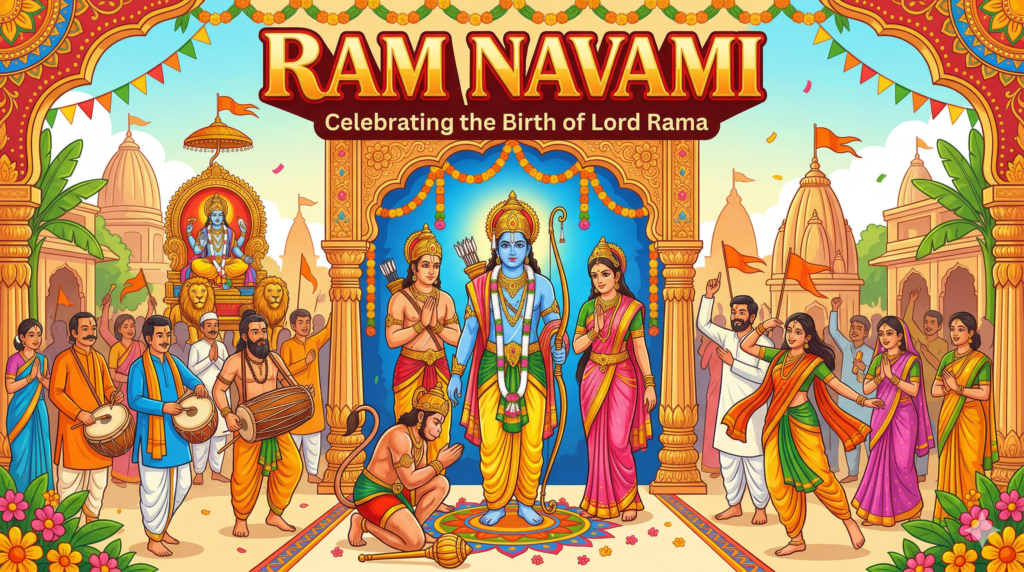
Introduction to the Ram Navami Festival
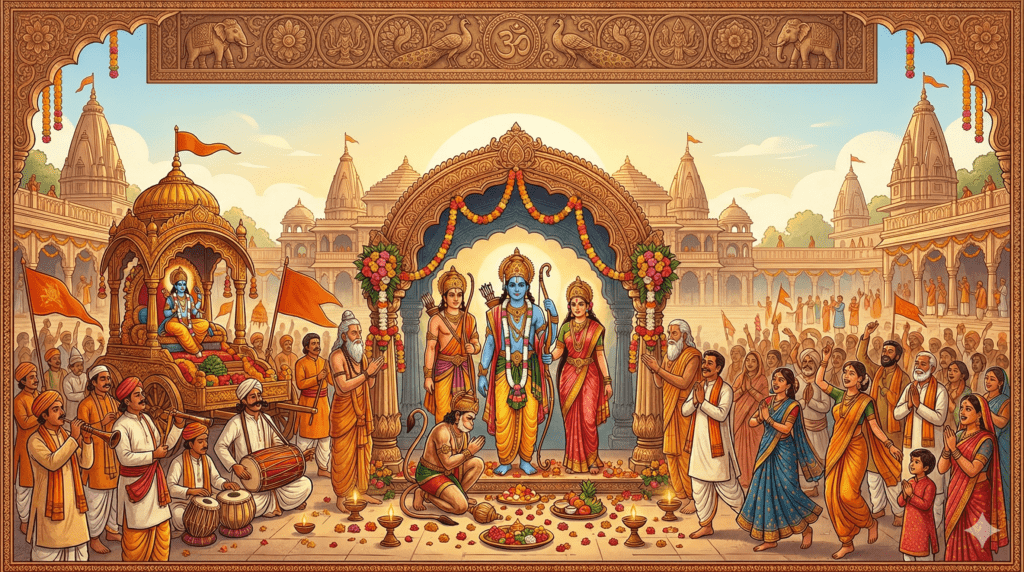
The observance of Ram Navami occupies a position of paramount importance within the liturgical and cultural frameworks of the Hindu tradition, serving as the annual commemoration of the terrestrial manifestation of Lord Rama, universally revered as the seventh incarnation, or avatar, of the preserver deity, Lord Vishnu. According to the precise astronomical calculations of the traditional Hindu lunisolar calendar, this auspicious occasion unfolds on the Navami tithi, which corresponds to the ninth day of the Shukla Paksha, or the bright, waxing phase of the moon. This specific lunar phase falls within the sacred month of Chaitra, aligning temporally with the months of March or April in the Gregorian calendar. Notably, Ram Navami does not exist in isolation; it functions as the grand culmination of the Chaitra Navaratri, a nine-day period of intense spiritual austerity, fasting, and the veneration of the Divine Mother, thereby seamlessly intertwining the theology of divine birth with the broader themes of spiritual renewal and the triumph of righteousness.
Far beyond serving as a mere historical anniversary or a localized regional holiday, Ram Navami is interpreted across diverse theological traditions as a profound cosmic phenomenon. It represents the deliberate descent of the Supreme Reality into the constrained realm of human existence, an act necessitated by the urgent imperative to restore cosmic order, known as Dharma, and to systematically eradicate unrighteousness, or Adharma. The narrative of Lord Rama, fundamentally enshrined in the ancient Sanskrit epic, the Valmiki Ramayana, and subsequently democratized for the masses through Goswami Tulsidas’s Awadhi masterpiece, the Ramcharitmanas, permeates the socio-cultural, ethical, and spiritual consciousness of the entire Indian subcontinent, as well as its vast and vibrant global diaspora.
The celebration of Ram Navami is inherently multidimensional. It encompasses rigorous spiritual austerities such as waterless fasts, intricate temple liturgies involving specialized fire sacrifices, grand public processions featuring elaborately adorned chariots, regional dramatic folk re-enactments that transform entire cities into mythic landscapes, and deeply symbolic culinary traditions designed to synchronize human physiology with the shifting seasons. Through an exhaustive, multi-disciplinary examination of its mythological foundations, scriptural injunctions, philosophical paradigms, and the vast spectrum of its regional variations, this comprehensive report elucidates how Ram Navami functions not merely as a religious holiday, but as an enduring blueprint for ethical living, societal harmony, and ultimate spiritual illumination.
Mythological and Scriptural Foundations of the Divine Descent
The ontological premise of Ram Navami is deeply rooted in the classical Hindu narrative of divine intervention, which asserts that when the equilibrium of the cosmos is threatened by the proliferation of demonic forces, the Divine must incarnate to restore balance. The historical and mythological genesis of this specific festival centers entirely on the royal household of the ancient city of Ayodhya, located in the modern-day state of Uttar Pradesh, India.
The Lineage of the Solar Dynasty and the Puthra Kamesti Yagna
The narrative commences with King Dasharatha, a noble and righteous ruler belonging to the illustrious Suryavansh, or the Solar Dynasty. Despite his vast empire and moral superiority, Dasharatha and his three principal queens—Kausalya, Kaikeyi, and Sumitra—were afflicted by a profound sorrow: they were bereft of a male heir, causing deep distress over the future stability and governance of the Ayodhya kingdom. Recognizing the geopolitical and spiritual crisis this vacuum presented, the royal preceptor, the great Rishi Vasistha, advised the monarch to undertake a highly specialized and potent Vedic fire sacrifice.
Under the specific liturgical authority of Sage Rishyasringa, King Dasharatha orchestrated the Puthra Kamesti Yagna, a complex ritual designed exclusively to invoke divine blessings for the conception of progeny. The scriptural accounts, particularly those analyzed within the Vaishnava tradition, emphasize that this yagna was not merely a mechanical or transactional ritual, but rather a profound act of spiritual surrender and discipline. The convergence of divine will, the precise guidance of an enlightened guru, the profound spiritual yearning of the royal family, and the desperate readiness of a world oppressed by the demon king Ravana all coalesced during this sacrifice.
At the successful culmination of the sacrificial rites, a celestial phenomenon occurred. Agnidev, the deity of fire, physically manifested from the burning altar, bearing a sacred vessel containing a divine pudding, commonly referred to as kheer, payasam, or celestial rice and milk. Agnidev instructed King Dasharatha to distribute this consecrated offering, or prasadam, among his three queens. The consumption of this divine nectar led to the pregnancies of the queens. Consequently, Queen Kausalya gave birth to Rama, Queen Kaikeyi to Bharata, and Queen Sumitra bore twins, Lakshmana and Shatrughna, thereby fulfilling the king’s desire and ensuring the continuation of the royal lineage.
Astronomical Alignment, Cosmic Timing, and Theological Metaphor
The specific timing of Lord Rama’s birth is meticulously documented in both astrological and scriptural texts, laden with profound esoteric significance. He incarnated on the Navami tithi of the Chaitra month, under the astrological influence of the Punarvasu Nakshatra (lunar mansion). Crucially, the birth occurred precisely at Madhyahna, or midday, when the sun reached its absolute zenith in the sky.
This specific temporal alignment is not viewed as coincidental; rather, it serves as a powerful metaphysical metaphor. The appearance of the deity at exact noon symbolizes absolute divine illumination, the total dispelling of the darkness of human ignorance, and the zenith of righteousness. Furthermore, esoteric theological texts, such as those expounded by spiritual leaders like Swami Mukundananda, indicate that Lord Rama did not immediately appear in the mortal realm as a helpless, crying human infant. Instead, to demonstrate his supreme divinity to his mother, he first manifested before Queen Kausalya in his resplendent, divine, four-armed form. It was only after this revelation, and out of boundless love for his devotees who desired a personal relationship with the divine, that he voluntarily chose to assume the form of a human child. This narrative transforms the birth of Lord Rama from a mere historical event into a comprehensive spiritual blueprint, illustrating how devotion and humility can literally invite the Supreme Reality to descend into the human heart.
Philosophical Dimensions: The Paradigm of Maryada Purushottam
The enduring cultural resonance and sociological impact of Ram Navami cannot be fully comprehended without engaging in a rigorous analysis of the character of Lord Rama himself. Throughout the vast expanse of Hindu philosophy and literature, Lord Rama is universally revered by the exalted title of “Maryada Purushottam”. This profound Sanskrit epithet translates directly to the “supreme man of ethical and moral conduct,” or the “perfect man”.
The theological concept encapsulated by this title is that while Lord Rama possessed the totality of divine power and cosmic authority as an incarnation of Vishnu, he intentionally bound himself to the rigid constraints of human morality, societal duty, and ethical conduct. He did not utilize his divinity to bypass human suffering or to assert arbitrary power; instead, he chose to walk the earth as the ideal son, the ideal husband, the ideal king, and the ideal warrior, thereby setting a flawless, replicable precedent for humanity to navigate the complexities of existence.
The Sixteen Divine Virtues (Shodasha Kala Sampurna)
Classical scriptural texts enumerate sixteen specific, quantifiable virtues that Lord Rama perfectly embodied throughout his earthly sojourn. The festival of Ram Navami serves as a dedicated period for devotees to engage in deep introspection, utilizing these sixteen virtues as a mirror to assess and cultivate their own moral integrity and spiritual growth.
| Sanskrit Nomenclature | Translation and Narrative Application in the Life of Lord Rama |
| Gunavaan | Endowed with principled, excellent qualities that underlie all internal thoughts and external actions. |
| Veeryavan | Possessing unmatched physical prowess, moral courage, and spiritual stamina. |
| Dharmajnah | Consistently and unyieldingly righteous, invariably placing universal duty above personal desire. |
| Krithajnah | Expressing profound, abiding gratitude for even the most minuscule assistance rendered by others. |
| Satyavaakyah | Unwaveringly truthful in all statements; famously demonstrated by honoring his father’s complex promises without hesitation. |
| Dhrida Vratah | Resolute and firm in vows and deeds; exemplified by his unwavering commitment to a fourteen-year forest exile. |
| Chaarithrena | Demonstrating impeccable personal conduct, character, and unimpeachable social etiquette. |
| Sarvah Bhuteshu Hitah | Acting continuously as a compassionate benefactor to all living entities, transcending species and social hierarchies. |
| Vidvaan | Possessing absolute, omniscient knowledge, supreme wisdom, and total clarity of thought. |
| Samarthah | Supremely competent in achieving seemingly impossible tasks, such as engineering a bridge across the ocean to Lanka. |
| Eka Priya Darshanah | Solely delightful and enchanting in physical appearance, acting as a direct reflection of perfect inner purity. |
| Aatmavan | Supremely courageous and self-possessed, remaining unshakeable in the face of insurmountable odds. |
| Jita Krodhah | The absolute conqueror of anger, malice, and all base, reactive emotional impulses. |
| Dhyutimaan | Endowed with an inner, radiant splendor, charisma, and undeniable spiritual brilliance. |
| An-Asuyakah | Completely and entirely free from the corrosive emotions of envy, jealousy, or resentment. |
| Jaata Roshasya | Formidable, terrifying, and utterly fearless in righteous warfare when provoked by the forces of evil and injustice. |
Practical Applications of Rama’s Philosophy in Modern Contexts
The overarching narrative of the Ramayana is not merely a mythological fantasy; it functions as a highly sophisticated ethical treatise that remains profoundly applicable to modern social, political, and psychological challenges. During Ram Navami, religious discourses and blog publications frequently highlight these practical life lessons to inspire modern youth and civic leaders.
The primacy of Dharma, or righteousness, is the foundational lesson. Lord Rama’s willing acceptance of a fourteen-year exile to the dangerous Dandaka forest—solely to honor a boon his father, King Dasharatha, had mistakenly granted to Queen Kaikeyi—represents the ultimate sacrifice of personal comfort and legitimate political power for the preservation of institutional integrity and filial piety. This action underscores the profound interconnectedness of human actions and the paramount importance of honoring one’s commitments, teaching modern society that an individual’s moral character must not falter due to personal hardship.
Furthermore, the epic illustrates extraordinary resilience and equanimity in the face of severe adversity. Throughout trials involving his sudden exile, the traumatic abduction of his beloved wife Sita by the demon king Ravana, and the execution of a devastating, multi-year war, Lord Rama maintained total emotional and psychological equilibrium. He accepted his exile as a divine decree, illustrating that resilience is not about avoiding hardship, but rather the ability to bounce back from setbacks, view challenges as opportunities for growth, and draw strength from an unwavering faith in the cosmic order.
Egalitarian compassion and ethical leadership constitute another major philosophical pillar. Lord Rama’s interactions consistently transcended the rigid social stratifications of his era. His profound respect for Kevat, the humble boatman whose sincere service earned him divine blessings, and his alliance with the Vanara (forest-dwelling monkey) army, demonstrate that true devotion, nobility, and worthiness transcend societal hierarchy, caste, economic status, and even species. As a ruler, his administration, conceptually known as “Ram Rajya,” remains the archetypal Indian political model for a utopian welfare state. It envisions a society characterized by absolute justice, the complete eradication of poverty, universal welfare, and a sovereign who prioritizes the needs of the most marginalized citizens above any personal attachments or familial privileges.
Ritualistic Observances and the Mechanics of Fasting
The practical observance of Ram Navami is defined by rigorous spiritual discipline, prominently featuring the practice of fasting (vrata), early morning ablutions, extensive temple visitation, and the continuous recitation of sacred texts. These elaborate rituals are explicitly designed to purify the devotee’s consciousness, invoke divine grace, and facilitate profound spiritual renewal.
The Strict Protocols of the Ram Navami Vrat
Observing a fast on Ram Navami is widely considered a deeply purifying, and in many sects, mandatory spiritual practice. The fast traditionally commences at dawn, and its specific strictness varies significantly based on regional customs, sectarian affiliation, and the individual’s physiological capacity.
| Fasting Classification | Detailed Description and Dietary Restrictions |
| Nirjala Vrat | A highly austere, completely waterless fast. Devotees adopting this extreme discipline abstain from all food and liquid from the sunrise of Ram Navami until the sunrise of the following day. |
| Phalahar (Sattvic) Vrat | A partial, modified fast that permits the consumption of a single meal composed entirely of sattvic (pure, non-stimulating) foods. Permitted items include fresh fruits, milk, sabudana (sago), kuttu (buckwheat) flour, and potatoes, strictly avoiding grains, onions, and garlic. |
| Anukalpa Vrat | A specialized fast predominantly observed by specific Vaishnava communities (such as ISKCON and Gaudiya Mathas), which is similar to standard Ekadashi protocols, restricting all grains and beans but allowing specific root vegetables and dairy. |
Theological Nuances of Concluding the Fast (Parana)
The timing and methodology of concluding the fast, known as the Parana, reveal fascinating sectarian diversity and complex theological logic, as detailed in medieval liturgical manuals like the Nirnaya-sindhu and the Hari-bhakti-vilasa. Because Lord Rama incarnated precisely at midday, traditional ritual logic dictates that the principal worship ceremony (Madhyahna Puja) cannot authentically occur until that specific hour. Consequently, the absolute minimum duration for any Ram Navami fast is until noon; one cannot logically break a birth-fast before the deity has actually appeared and been offered the first sanctified food.
However, deeper scriptural injunctions present further complexities for orthodox practitioners. The Hari-bhakti-vilasa explicitly mandates that a complete fast should last from sunrise on Ram Navami to sunrise on the subsequent day, known as Dashami. On the morning of Dashami, the devotee must first complete their eternal daily duties (Nitya Karma, such as sandhya vandanam and daily mantra chanting), perform a comprehensive worship of Lord Rama, satisfy their spiritual master (Acharya), and then break the fast by consuming the offered prasadam and providing charitable donations (Dakshina) to the brahmanas.
A critical theological caveat addresses potential scheduling conflicts. If an unavoidable logistical or ritual problem arises that prevents the devotee from completing the full morning worship before the narrow, astronomically calculated time window for breaking the fast expires, the scriptures offer a specific contingency. The devotee must symbolically break the fast by imbibing merely a few drops of consecrated water. This highly specific action satisfies the requirement of completing the occasional duty (the vrata) within the correct astrological window, without inappropriately interrupting or superseding the eternal, mandatory duty of comprehensive morning worship.
Vibrational Theology: Sacred Chants, Shlokas, and Mantras
The vibrational science of Sanskrit mantras forms a critical, transformative component of Ram Navami rituals. In Hindu theology, the chanting of these precise sonic formulas is not merely symbolic; it is believed to possess the objective capacity to restructure the practitioner’s consciousness, balance neurological functions, and invoke divine frequencies that manifest health, prosperity, and ultimate spiritual liberation.
Throughout the festival, and often for the preceding nine days during a practice known as Navahna Parayana, households and temples resonate with the continuous recitation of the Valmiki Ramayana, the Vishnu Sahasranama, and the Ramcharitmanas. Devotional congregational singing (Bhajan and Kirtan) extolling the virtues of the divine family is ubiquitous.
| Sacred Invocation / Mantra | Transliteration | Theological Meaning, Translation, and Spiritual Application |
| Ram Tarak Mantra | Sri Rama Jai Ram Jai Jai Ram | Translated simply as “Victory to Lord Rama.” This is a profoundly powerful, foundational chant utilized heavily for congregational singing and Nama Japa (the meditative practice of repeatedly writing the holy name). It is specifically prescribed to foster internal psychological harmony, universal peace, and profound self-assurance. |
| Ram Gayatri Mantra | Om Dashrathaye Vidmahe Sita Vallabhaye Dhimahi Tanno Ramah Prachodayat | Modeled on the ancient Vedic Gayatri meter, this mantra invokes Rama specifically in his roles as Dasharatha’s son and Mother Sita’s husband. It is chanted primarily for psychic protection and asks the Lord to grant deep wisdom and the cognitive ability to make righteous decisions. Esoterically, chanting this specific Sita-Ram mantra is believed to harmonize and balance the left and right hemispheres of the human brain. |
| Kama Bija Ram Mantra | Om Kleem Namo Bhagavathey Raamachandraaya sakalajana vashyakaraaya Swaaha | This highly specialized tantric mantra utilizes the Kleem beej (seed) syllable. The sonic frequency of this seed acts as a magnetic attractor to draw material prosperity, universal joy, and overall success into the life of the dedicated practitioner, representing the Lord’s capability to foster harmony across the cosmos. |
| Ramcharitmanas Doha | Mangal Bhavan Amangal Haari / Dravau So Dasarath Ajir Bihaari | Translated as: “May He who is the very abode of auspiciousness and the ultimate destroyer of all that is inauspicious, the one who once played freely in King Dasharatha’s courtyard, be moved with compassion and bless us.” This is arguably the most beloved and widely recited opening shloka of all Ram Navami celebrations across North India. |
| Valmiki Ramayana Shloka | Ramo Vigrahavan Dharmah Sadhuh Satya Parakramah / Raja Sarvasya Lokasya Devanam Iva Vasavah | Translated as: “Rama is dharma itself in human form. He is noble, and his courage is rooted in absolute truth. He is the king of all the worlds, just as Indra is the sovereign of the gods.” This shloka serves as the ultimate philosophical declaration of Rama’s dual nature as human exemplar and cosmic sovereign. |
| Mool Mantra / Greeting | Om Shri Ramaya Namah / Jai Shri Ram | The foundational invocation used during the principal puja to invoke the deity’s presence, and the universal greeting utilized by millions to express solidarity, devotion, and wishes for peace and divine strength. |
During the festival, the exchange of greetings forms a vital social component, reinforcing community bonds. Expressions such as “Ram Navami ki shubhkamnayein” in Hindi, or corresponding well-wishes in regional languages like Odia, are exchanged digitally and in person, emphasizing the desire for the recipient’s home to be filled with divine blessings, the courage to overcome obstacles, and the continuous guidance of Dharma.
The Ayodhya Epicenter and the Surya Tilak Phenomenon
While Ram Navami is celebrated with immense fervor across the globe, the ancient city of Ayodhya—the geographical and historical birthplace of the deity—serves as the undisputed epicenter of the festivities. Following the monumental completion and consecration of the Shri Ram Janmabhoomi temple in early 2024, the scale, logistical complexity, and emotional intensity of these celebrations have been elevated to unprecedented historical heights.
The physical environment of Ayodhya undergoes a massive, meticulously planned transformation. Millions of pilgrims converge on the city, initiating their spiritual observances by undertaking ritual, purifying ablutions in the sacred Sarayu River. To manage the monumental influx of devotees amidst the soaring spring temperatures, local administrations and temple trusts deploy extensive modern infrastructure. This includes the innovative use of drone technology to mist cooling Sarayu water over the densely packed crowds, the establishment of hundreds of hydration and medical camps along the Rampath, and the spectacular illumination of over 200,000 earthen lamps (diyas) across the Pakka Ghat and Ram’s Paidi, transforming the city into a radiant beacon of devotion.
The Synthesis of Science and Theology: The Surya Tilak Ritual
The most anticipated, awe-inspiring, and globally broadcast event of the contemporary Ayodhya celebration is the Surya Tilak ritual. Conducted exactly at 12:00 PM (noon), this unprecedented ceremony represents a breathtaking, flawless synthesis of ancient theological symbolism and cutting-edge optomechanical engineering.
Because Lord Rama is revered as a direct scion of the Suryavansh (the Solar Dynasty), the direct, physical veneration of the deity by the Sun God (Surya) holds immeasurable mythological significance. To actualize this ancient poetic concept in the modern era, leading Indian scientists and astronomical engineers designed a highly sophisticated, completely gear-less optomechanical system. This apparatus utilizes a precise, mathematically calculated arrangement of high-quality lenses and specialized mirrors installed within the temple’s architecture.
On the specific day of Ram Navami—which, due to precise local astronomical and traditional calculations, is scheduled for March 27 in Ayodhya in 2026, a day later than the observance in some other regions—this apparatus captures ambient sunlight from the temple’s upper elevations. The light is then systematically reflected and refracted through a complex piping system, traversing the architecture to enter the subterranean sanctum sanctorum (garbhagriha). At exactly noon, coinciding with the divine moment of birth and the performance of the noon aarti, the concentrated beam of sunlight is focused directly onto the forehead of the Ram Lalla (infant Rama) idol.
This optical precision creates a dazzling, blazing tilak composed entirely of pure sunlight, which rests brilliantly on the deity’s forehead for approximately four minutes. Recognizing that millions of gathered devotees are unable to physically enter the sanctum during this brief window, the temple trust suspends all VIP darshan privileges to maintain egalitarian access, and simultaneously broadcasts this celestial alignment live on massive television screens installed throughout the city, as well as via global news networks. This allows devotees worldwide to bear witness to a profound intersection where cosmic timing, scientific precision, and deep religious devotion seamlessly converge.
Regional Variations, Dramatic Traditions, and Syncretism
India’s vast geographic expanse and cultural diversity ensure that Ram Navami is not a monolithic, standardized observance. Different geographic zones have evolved highly specific, culturally rich traditions, integrating local folklore, indigenous arts, and complex sociological dynamics into the core Ramayana narrative.
North India: The Immersive Theater of Ramlila
In Northern India, particularly within the states of Uttar Pradesh and Bihar, the festival is heavily associated with the Ramlila—a dramatic, folk-art re-enactment of the Ramayana that is so culturally significant it has been officially recognized by UNESCO as an Intangible Cultural Heritage of Humanity. While Ramlilas are globally famous during the autumn Navaratri (Dussehra) festival culminating in the burning of Ravana effigies, significant and elaborate performances also align directly with Ram Navami.
The most extraordinary and historically preserved expression of this tradition is the Ramnagar Ramlila, situated in Varanasi. Unlike standard abridged plays, this is an immersive, 31-day operatic pantomime generously sponsored by the local Maharaja. During this month, the entire physical city of Ramnagar is conceptually transformed into a mythic geography, with specific urban locations designated to represent epic sites such as Lanka, Panchavati, and Janakpuri. The audience does not sit passively; they physicalize their devotion by migrating across the city alongside the amateur acting troupes (known as Mandalis), fundamentally participating in a shared, immersive religious experience rather than merely observing a theatrical play.
South India: Celestial Weddings and Classical Musical Devotion
In the southern states, particularly Andhra Pradesh and Telangana, the focus of Ram Navami shifts from the birth narrative to a grand nuptial celebration. At the historic 17th-century temple in Bhadrachalam, situated majestically on the banks of the Godavari River, the festival is marked by the grand Sri Ramanavami Kalyanam Utsava. This highly elaborate ritual re-enacts the celestial wedding of Lord Rama and Goddess Sita, viewing their union as the ultimate symbol of cosmic balance and marital devotion. The state government traditionally participates by officially offering pearls and silk garments to the deities, while millions of devotees gather to witness the divine union. The region also integrates indigenous culture, with local tribal museums promoting the deep, localized connections to the Ramayana narrative.
In the state of Karnataka, the observance is uniquely characterized by high classical culture and auditory devotion. The Sree Ramaseva Mandali in Bengaluru orchestrates a monumental, month-long classical music festival that has been running continuously for over eight decades. Originating in 1939, this prestigious event draws hundreds of thousands of attendees and features the absolute zenith of both Carnatic and Hindustani musical talent, treating classical music not as entertainment, but as Nada Yoga—a profound form of sonic, divine offering to Lord Rama. Legendary figures such as M.S. Subbulakshmi and K.J. Yesudas have performed here for decades, cementing its status as the “Temple of Music”.
Eastern India: Sociological Harmony, Folk Theater, and the Chariot Connection
The eastern state of Odisha offers some of the most sociologically rich and distinct celebrations of Ram Navami in the subcontinent. In the state capital, Bhubaneswar, the prominent Ram Mandir located on Janpath road becomes the spiritual focal point. Thousands of devotees, often including the Chief Minister and high-ranking officials, queue for hours to offer prayers in a highly organized, deeply pious atmosphere monitored tightly by local police administrations to ensure peace and order.
However, it is in the rural and semi-urban landscapes of Odisha that truly unique dramatic traditions emerge. In Mallipur village, located within the Nischintakoili block of the Cuttack district, a specialized 11-day Jatra (traditional folk theater) is enacted. Uniquely, the actors—known as Suangis, who inherit their roles hereditarily and maintain strict dietary and spiritual purity during the entire festival—do not deliver any spoken dialogue. Instead, they perform highly stylized, silent physical acting and dance, their bodies entirely painted in vibrant water colors. The narrative of the Valmiki Ramayana is chanted rhythmically by a dedicated reciter, known as the Bachanika, situated off-stage, to the accompaniment of traditional percussion instruments like the Pakhawaja and Gini. This preserves an ancient, unadulterated form of storytelling devoid of modern commercial dilution.
The city of Cuttack also provides a powerful, enduring counter-narrative to modern communal friction, earning its moniker as the ‘City of Brotherhood’. Ram Navami here stands as a profound testament to deep-seated syncretic harmony between the Hindu and Muslim communities. Because the lunisolar calendars frequently align Ram Navami with the Islamic holy month of Ramadan, the communities engage in remarkable mutual cooperation. Muslim artisans in Cuttack, such as Zahir and Shahid Khan, historically and enthusiastically craft the intricate, multicolored decorations, tableaux, and divine crowns utilized in the elaborate Ram Navami temple processions. Simultaneously, Hindu neighbors share food and participate in breaking the Ramadan fast (Iftar) with these artisans, actively demonstrating that the festival’s core message of Dharma encompasses universal brotherhood, civic peace, and mutual respect.
Furthermore, in the sacred coastal city of Puri, Ram Navami marks a critical, preliminary logistical and ritual phase for the world-famous Jagannath Ratha Yatra. It is during this precise period that the intricate carving and construction of the sacred Neem wood (Daru) begins for the creation of the three massive, multi-tiered chariots—Nandighosha for Lord Jagannath, Taladhwaja for Balabhadra, and Darpadalana for Subhadra. This highlights the deeply interconnected nature of the Vaishnava liturgical calendar, linking the birth of the Rama avatar directly to the grand public festival of the Krishna/Jagannath avatar.
The Global Diaspora
Internationally, Ram Navami serves as a vital cultural tether for the vast Indian diaspora, particularly those descended from indentured laborers. In nations such as South Africa (specifically Durban), Trinidad and Tobago, Guyana, and Fiji, the festival has been meticulously maintained since the colonial era. It is marked by the continuous recitation of the Ramayana and the singing of traditional bhajans composed by saints like Tyagaraja and Bhadrachala Ramdas, serving as a powerful mechanism for preserving linguistic and religious identity across generations and oceans. Furthermore, global organizations like ISKCON ensure the strict observance of the Ram Navami fasts and the elaborate, joyous worship of the deity across major international metropolises.
Culinary Anthropology: Sacred Prasad and Seasonal Ayurvedic Wisdom
The specific food offerings (prasadam) prepared and distributed during Ram Navami are not arbitrarily selected based on taste; rather, they represent a highly sophisticated, indigenous knowledge system that seamlessly combines Ayurvedic medicine, regional agricultural cycles, and climate adaptation. Because the Chaitra Navami festival inevitably occurs at the onset of the brutal, dehydrating Indian summer, the traditional prasad is explicitly formulated to hydrate the body, drastically reduce core temperature, and maintain vital electrolyte balances for fasting devotees.
Panakam: The Sacred Ayurvedic Nectar
The most ubiquitous and culturally significant offering, particularly widespread across South India and Odisha, is a beverage known as Panakam (also spelled Panagam or Panaka). Revered in folklore as Lord Rama’s absolute favorite drink, Panakam is fundamentally a zero-waste, unrefined, highly effective summer cooler.
The formulation of this beverage is highly scientific in its application of Ayurvedic principles:
- Jaggery (Unrefined Cane Sugar): Serves as the primary base, providing an immediate, sustained energy boost and acting as a crucial electrolyte for exhausted devotees. Symbolically, the visual act of jaggery dissolving completely in water represents the melting away of life’s earthly sorrows and karmic burdens through the application of divine grace.
- Dry Ginger Powder (Sonth) and Black Pepper: These sharp spices are deliberately added to stimulate the digestive fire (Agni). According to Ayurveda, internal digestion naturally weakens during periods of extreme external environmental heat; these spices counteract that lethargy.
- Cardamom Pods and Edible Camphor: Provide deep aromatic cooling properties and soothe the gastrointestinal tract.
- Fresh Lemon Juice: Adds a critical dose of Vitamin C and further assists in balancing the body’s internal heat.
Ayurvedic medical principles indicate that intense summer heat severely exacerbates the Pitta dosha within the human body, a physiological imbalance that directly leads to psychological irritation, irrational anger, and physical inflammation. By consuming Panakam, the physical body is rapidly cooled and physiologically stabilized. This physical stabilization, in turn, facilitates the deep psychological calmness, patience, and equanimity that Lord Rama perfectly embodied, thus aligning the devotee’s physical state with their spiritual aspirations.
Neer Mor and Kosumalli: Probiotics and Plant Protein
Accompanying the sweet Panakam are two other vital, scientifically grounded seasonal preparations. Neer Mor is a highly diluted, extensively spiced buttermilk. It is infused with crushed ginger, sharp green chilies, fresh curry leaves, coriander, and a crucial pinch of asafoetida (hing), often tempered with mustard seeds in oil. This preparation acts as a powerful, natural probiotic thirst quencher. It specifically aids in digesting the heavy festive meals or safely breaking the day-long fast without shocking the digestive system.
To provide sustenance without lethargy, devotees consume Kosumalli (also known as Kosambari). This is a completely raw, highly nutritious salad constructed primarily from soaked, protein-rich moong dal (split yellow lentils). These lentils are mixed with highly hydrating vegetables, such as finely chopped cucumber or grated raw mango, and finished with a light tempering of mustard seeds, green chilies, and freshly grated coconut. Because devout observers undergo rigorous fasting and require energy to participate in lengthy temple processions, Kosumalli provides easily digestible plant-based protein, essential vitamins, and dietary fiber without initiating the severe lethargy and heaviness associated with heavily cooked, carbohydrate-dense meals.
In a profound display of civic duty, religious charity, and communal care, these specific dietary items are prepared in vast, industrial quantities and distributed entirely freely to the general public. Temple trusts, neighborhood committees, and local volunteer organizations set up roadside pavilions (panthals) to hand out Panakam and Neer Mor to anyone passing by. This practice beautifully democratizes the blessings of the festival, ensuring that the critical heat-relief provided by these Ayurvedic preparations reaches the most vulnerable members of the populace, perfectly echoing Lord Rama’s ethos of universal welfare and compassionate governance.
Conclusion
An exhaustive, multi-disciplinary analysis of Ram Navami reveals a festival that comprehensively exceeds the simplistic parameters of a mythological birthday celebration. It stands as a highly complex, multi-layered cultural, theological, and sociological phenomenon that serves indispensable functions within the broader Hindu ecosystem.
Theologically, the festival forcefully reiterates the ancient promise of divine intervention in the face of insurmountable worldly evil, establishing Lord Rama not merely as a deity to be worshipped, but as the ultimate, replicable paradigm of the Maryada Purushottam—the supreme ethical ideal. The rigorous fasting protocols, the meticulous scriptural recitations, and the specific sonic vibrations of the sacred Sanskrit mantras offer dedicated practitioners a highly structured, time-tested methodology for deep self-purification and cognitive restructuring.
Sociologically, the festival acts as an incredibly powerful, enduring unifying mechanism across a diverse subcontinent. Whether through the mass, classless immersion of the Ramnagar Ramlila in Varanasi, the poignant communal harmony demonstrated by the Muslim artisans of Cuttack during the holy month of Ramadan, or the highly organized, egalitarian distribution of seasonal, Ayurvedic cooling foods like Panakam and Neer Mor, Ram Navami continuously reinforces the foundational societal values of charity, community support, and universal egalitarianism.
Finally, as spectacularly evidenced by the awe-inspiring Surya Tilak ritual executed within the newly consecrated Ayodhya Mandir, Ram Navami possesses the unique, vital capacity to evolve and adapt. By utilizing cutting-edge optomechanical engineering to flawlessly execute ancient astronomical and mythological mandates, the modern celebration of Ram Navami perfectly encapsulates the Indian civilizational ethos: a society firmly and proudly rooted in deep, ancient spiritual truths, yet entirely capable of expressing and amplifying that devotion through the absolute zenith of modern scientific innovation. In celebrating the birth of Lord Rama, humanity is not merely looking backward at a historical epic; rather, it is continuously invited to give birth to those exact same virtues of unyielding dharma, profound resilience, and boundless, universal compassion within the landscape of their own modern consciousness.