Introduction to the Eternal City of Devotion
Mathura stands not merely as a geographical coordinate on the map of Uttar Pradesh, India, but as a living, breathing epicenter of divine consciousness. Recognized universally as the birthplace of Lord Krishna, the eighth avatar of the Supreme Lord Vishnu, Mathura operates as the spiritual nucleus of the wider Braj Bhoomi region.
For millennia, this crescent-shaped city, cradled lovingly by the winding currents of the sacred Yamuna River, has drawn millions of pilgrims, scholars, saints, and spiritual seekers from across the globe.
This exhaustive report provides a granular, deeply analytical exploration of Mathura’s historical evolution, scriptural foundations, sacred geography, architectural marvels, vibrant festivals, and unique cultural heritage. It is designed to serve as a comprehensive foundational document for understanding the ontological reality and cultural magnitude of this ancient city, providing readers of ridhyaspiritual.com with a profound understanding of why Mathura remains the beating heart of Hindu devotion.
The Scriptural and Historical Foundations of Mathurapuri
Ancient Origins and Epic Puranic Accounts
The ontological existence of Mathura is documented in canonical texts that predate recorded human history by thousands of years. According to Puranic literature, the city known as Mathurapuri existed long before the advent of Lord Krishna.
The earliest epic reference to the region in recorded scripture is found in the Ramayana, widely considered the oldest Indian epic. The area was initially characterized as a dense, terrifying forest known as Madhuvan, which was ruled by a formidable and oppressive demon named Lavanasura.
During the subsequent Dvapara-yuga, the specific era of Lord Krishna’s descent, Mathura served as the wealthy and powerful capital of the illustrious Surasena Kingdom.
Scriptural Sanction and Theological Supremacy
The sanctity and absolute supremacy of Mathura are heavily codified in the most esoteric Hindu texts. The Gopala Tapani Upanishad explicitly confirms that Mathura is a terrestrial manifestation of the spiritual world itself. It states that just as there are seven desire-fulfilling cities situated on the summit of the cosmic Mount Sumeru, there are seven such cities on Earth, with Gopala Puri (Mathura) functioning directly as the spiritual realm.
Furthermore, the Padma Purana asserts the exclusivity of Mathura’s spiritual dimension. It claims that the true, radiant spiritual form of Mathurapuri cannot be perceived by ordinary material vision; it is only revealed to those whose consciousness has been thoroughly purified through intense meditation, pious activities, and severe austerities.
The Historical Timeline: From Antiquity to the Modern Era
Beyond its scriptural and metaphysical existence, Mathura boasts a robust, thoroughly documented archaeological and historical record that proves its status as one of the oldest continuously inhabited cities in the world. Excavations at various sites across the city, particularly near the Katra region, have revealed pottery and terracotta artifacts dating back to the 6th century BCE, confirming its status as a major urban center during the Mahajanapada period.
As a city of immense wealth, cultural influence, and strategic geographical location along vital trade routes, Mathura has been a continuous target for imperial conquests, foreign invasions, and religious persecution throughout recorded history. The city’s timeline is one of extraordinary resilience, where periods of total devastation were invariably followed by miraculous architectural and spiritual rebirths.
| Historical Epoch / Event | Key Developments and Invasions in Mathura |
| 6th Century BCE | Functioned as the bustling, prosperous capital of the Surasena Kingdom. Early pottery and terracotta evidence confirm a highly advanced urban society. |
| 4th – 2nd Century BCE | Ruled by the vast Maurya Empire. The famous Greek ambassador Megasthenes, writing in the early 3rd century BCE, recorded Mathura as a great city under the Hellenized name Μέθορα (Méthora). |
| 180 BCE – 100 BCE | Fell under the direct or indirect administrative control of the Indo-Greeks. This influence is corroborated by the Yavanarajya inscription found in Maghera, indicating a period of “Yavana hegemony” and a blending of Greek and local Vedic cultures. |
| 1st Century BCE | Conquered by the Indo-Scythians, specifically the “Northern Satraps.” The first major attack by Greek armies on the city is recorded around 150 BCE. |
| 1st – 3rd Century CE | Reached a zenith of art, culture, and monumental architecture under the Kushan Empire. Mathura served as one of the empire’s two primary capitals, with regional rulers like Kharapallana and Vanaspara acting as vassals to the great King Kanishka. |
| 400 CE – 634 CE | Visited by prominent Chinese Buddhist monks and travelers Faxian and Xuanzang. Xuanzang documented a thriving, harmonious ecosystem containing twenty Buddhist monasteries and five massive Brahmanical temples. |
| 1018 CE | Suffered a catastrophic sacking by the Afghan invader Mahmud of Ghazni, resulting in the massive destruction of ancient, wealthy temple structures and the looting of the city’s treasures. |
| 1489 – 1517 CE | Sacked and brutally repressed again by Sikandar Lodhi, a ruler of the Delhi Sultanate who famously earned the epithet “Destroyer of Hindu deities” for his systematic demolition of sacred sites. |
| 1669 CE | Endured its most devastating architectural blow when the Mughal Emperor Aurangzeb ordered the destruction of the magnificent Keshav Dev Temple, erecting the Shahi-Eidgah Mosque directly over its sacred assembly hall. |
| 1759 CE | Subjected to a brutal, widespread invasion and plundering by the Afghan warlord Ahmad Shah Abdali. |
| 19th Century – 1947 | Absorbed into the British Empire until Indian Independence. This period saw the beginning of modern architectural revival efforts, funded largely by wealthy Hindu merchants and royal families. |
Despite facing near-total destruction on at least seventeen different occasions throughout its bloody and turbulent history, Mathura’s spiritual resilience ensured that its temples were consistently rebuilt, and its sacred traditions remained entirely unbroken.
The Architectural Marvels and Temples of Devotion
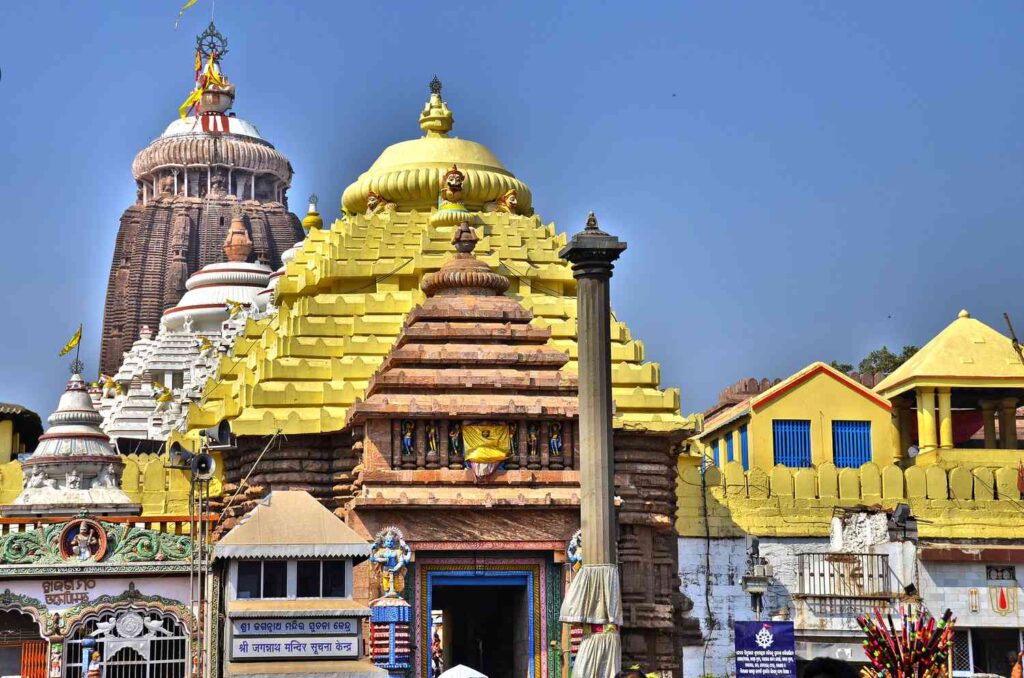
Mathura’s skyline is a breathtaking testament to its unyielding faith. The city’s temples are not merely places of worship or congregational gathering; they are architectural archives that hold the living memories of divine descents, royal patronage, and centuries of continuous devotional practice.
Shri Krishna Janmasthan Temple Complex: The Ground of the Divine Descent
The most critical, heavily venerated pilgrimage site in all of Mathura is the Shri Krishna Janmasthan Temple Complex. It is physically located in a deeply historic area historically known as Katra Keshavdeva, which translates literally to ‘the marketplace of Keshavdeva’.
The site’s history is characterized by a dramatic, heartbreaking cycle of magnificent construction and tragic demolition, reflecting the turbulent history of the Indian subcontinent:
The Original Temple: Traditions and scriptural lineages maintain that the very first temple on this holy site was built by Vajranabha, the great-grandson of Lord Krishna, who sought to institutionalize the worship of his divine ancestor.
The Gupta Era Reconstruction: Following centuries of wear and minor conflicts, a spectacular, massive new temple complex was commissioned and built by the Gupta Emperor Chandragupta II around 400 CE. This construction marked a golden age of Vaishnava architecture in the city, characterized by towering spires and exquisite stonework.
The Mughal Demolition: The temple reached an unprecedented scale of grandeur and wealth before becoming an object of intense envy and religious intolerance for invading rulers. In 1669 CE, the Mughal Emperor Aurangzeb razed the magnificent Keshav Dev Temple to the ground and constructed the Shahi-Eidgah Mosque directly over its sacred assembly hall (sabhamandapa), leaving only the sanctum sanctorum partially intact beneath the new structure.
Today, the modern Shri Krishna Janmasthan complex is a sprawling sanctuary that has reclaimed its former glory. The site houses several distinct, highly venerated shrines, each offering a unique theological experience
The Garbha Griha (Sanctum Sanctorum): This is the precise, geographical location of King Kamsa’s underground prison cell. It features a spacious veranda and a marble pavilion marking the exact birthplace of the Supreme Lord. The raw, austere appearance of the prison cell is deliberately preserved to invoke the historical reality of the divine birth, allowing devotees to meditate on the profound humility of the Supreme Lord choosing to appear in a dark, oppressive dungeon.
Shri Keshav Dev Temple: The modern landmark temple dedicated to Lord Krishna. The present structure, dedicated to the memory of Jadiadeva Dalmia by Ramakrishna Dalmia, began construction in June 1957 and was officially inaugurated in September 1958 by Hanuman Prasad Poddar. It stands as a symbol of modern Hindu architectural revival.
Bhagavata Bhavan: A magnificent, towering structure boasting five distinct shrines. The primary presiding deities are a mesmerizing, life-sized idol of Radha-Krishna. The structure also houses deities of Lord Jagannath, Rama, Sita, Hanuman, and Goddess Durga, representing the unified pantheon of the Hindu faith.
Yogmaya Shrine: Located near the Garbha Griha, specifically positioned against the rear wall of the Shahi Eidgah, this shrine is dedicated to the eight-handed Goddess Yogmaya. In Vaishnava theology, Yogmaya is the Lord’s internal spiritual potency, the divine energy who played a crucial role in the cosmic drama of Krishna’s birth by orchestrating the mystical transfer of the infants.
Potra Kunda (Pavitra Kunda): Situated to the southeast of the main temple complex, this is a large, deep, stepped water tank. It holds immense emotional and purificatory significance for devotees, as it is widely believed to be the sacred pool where mother Devaki washed the infant Krishna’s very first baby clothes.
Because of its sensitive history, the Shri Krishna Janmasthan complex is heavily fortified by Indian security forces. Visitors must pass through strict, multi-layered checkpoints. To preserve the sanctity, meditative atmosphere, and security of the site, all electronic devices, including cell phones and cameras, are strictly prohibited beyond the entrance.
Shri Dwarkadhish Temple: The Crown Jewel of Sovereign Majesty
While the Janmasthan marks the humble, miraculous beginning of Krishna’s earthly journey as an infant, the Shri Dwarkadhish Temple represents His ultimate sovereign majesty as the ruler of the universe. Built in 1814 by Seth Gokul Das Parikh, the immensely wealthy treasurer of the then Gwalior State (ruled by the Scindia dynasty), this temple is structurally recognized as one of the oldest, largest, and most stunning architectural achievements in modern Mathura.
The temple is an exquisite, flawless manifestation of Maru-Gurjara (traditional Rajasthani) architecture.
The Sanctum Sanctorum (Garbhagriha) houses the presiding deities in a state of unparalleled royal opulence. Unlike the majority of temples in the Braj region that depict Krishna as a simple, playful cowherd boy holding a flute, this temple worships Him in His majestic form as the King of Dwarka.
The visual contrast between the black and white marble is deeply symbolic, representing the union of the supreme energetic source (Krishna) and His supreme energy (Radha). The deities are worshipped with intense devotion and are adorned daily in magnificent, colorful silk garments, heavy gold and silver jewels, and fresh floral garlands, symbolizing their supreme divine and royal status over the cosmos.
The Four Dik-Palas: The Guardian Shiva Temples of Mathura
A profoundly nuanced theological aspect of Mathura’s sacred geography is the intricate, harmonious synthesis of Vaishnavism (the worship of Vishnu/Krishna) and Shaivism (the worship of Shiva). Despite Mathura being the undisputed, exclusive realm of Lord Krishna, it is spiritually guarded and regulated by Lord Shiva.
According to Puranic legends, when Lord Shiva arrived in Braj eager to catch a glimpse of the infant Krishna, Krishna recognized the deep devotion of the ascetic god. Krishna declared, “O Deva! You will be the protector of the Mathura region. After having your darshan, O Mahadev, people will attain the fruit of visiting my divine abode”.
Thus, Lord Shiva resides continuously in Mathura in the form of four ancient Dik-palas (Protectors of the Directions), stationed as sentinel guards at the four cardinal points of the city to protect the sacred dhama (holy land) from demonic influences and unpurified visitors.
| Directional Guard | Name of the Temple | Theological & Historical Significance |
| Western Guardian | Shri Bhuteshwar Mahadev | The most prominent and heavily visited of the four guardians. It is a rare, powerful confluence of Shaiva and Shakta traditions. The site is a recognized Shaktipeetha where Goddess Sati’s ringlet fell, radiating intense divine energy. It also houses the cave of Patal Devi, a deity who was worshipped by King Kansa himself. Worshiping here is said to guarantee liberation and perfection in all endeavors, as this specific form of Shiva is considered exceedingly dear to Krishna. |
| Southern Guardian | Shri Rangeshwar Mahadev | Located in the southern sector of the city. This serene, spiritually potent temple houses a Shivalinga that was historically established and intimately worshiped by King Kansa, the uncle of Lord Krishna. The temple becomes a massive hub of devotion during the holy month of Shravan and Maha Shivaratri. Celebrating Shivaratri here takes on a dual significance, as it marks both Lord Shiva’s auspicious day and the historical event of Kansa’s demise at the hands of Krishna. |
| Northern Guardian | Shri Gokarneshwar Mahadev | Guarding the northernmost part of the city, this temple is responsible for the spiritual and physical security of Krishna’s land. It features a highly venerated, ancient Shivalinga situated alongside a unique, magnificent four-foot-tall deity of Gokarn. |
| Eastern Guardian | Shri Pippleshwar Mahadev | Situated in the east, this temple forms the final, critical pillar of Mathura’s divine spiritual barrier, ensuring that the entire perimeter of the city is sealed by Shiva’s ascetic grace, allowing only sincere seekers to access the esoteric mysteries of Krishna’s abode. |
This unique theological dynamic demonstrates that in the absolute spiritual realm, there is no sectarian rivalry between the deities. Rather, Lord Shiva performs the highest, most intimate service to Lord Krishna by protecting His beloved city and filtering the consciousness of the pilgrims who attempt to enter it, proving that the ultimate truth is a unified, cooperative divine reality.
The Sacred Hydrology: Yamuna Maharani, Holy Ghats, and Restored Kunds
The spiritual ecosystem of Mathura cannot be fully understood without a deep comprehension of the River Yamuna. In the secular world, a river is a body of moving water; in Hindu theology, the Yamuna is Yamuna Maharani, a living, highly conscious Goddess who flows in the form of liquid compassion.
According to the Agni Purana, she is visualized in her divine form as dark in complexion, standing elegantly upon her vahana (vehicle)—a tortoise—while holding a water pot.
The 25 Sacred Ghats of Mathura
The riverfront of Mathura is adorned with exactly 25 distinct sacred bathing ghats (stepped riverbanks), each marking a specific divine pastime of Lord Krishna.
While Mathura hosts 25 ghats, the wider Braj region, particularly the neighboring town of Vrindavan, features an extended network of riverfront sanctuaries that pilgrims visit during their spiritual circuits. Some of the most highly venerated ghats across the region include:
Keshi Ghat: Where Krishna defeated the monstrous horse demon Keshi.
Radha Bagh Ghat: Known as a peaceful lover’s retreat for Radha and Krishna.
Sri Varaha Ghat: Where Lord Vishnu’s boar avatar is said to have appeared.
Chir Ghat: The site of divine sacrifice where a Brahmin’s wife offered her sari to Krishna.
Brahmand Ghat (in Gokul): The site where infant Krishna revealed the entire universe within his mouth to mother Yashoda.
Imli Tala Ghat: Famous for an ancient tamarind tree under which Krishna would rest.
Vishram Ghat: The Spiritual Heartbeat of the River
Of all the sacred riverfronts, Vishram Ghat in Mathura is unequivocally the most prominent, central, and visually spectacular.
Because of its unparalleled historical and theological significance, Vishram Ghat serves as the central anchor for the traditional Mathura Parikrama (the ritual circumambulation of the city). The outer parikrama, known as the Pancha Koshi Parikrama, is an arduous ten-mile barefoot walk that both begins and concludes at the sacred steps of Vishram Ghat.
The Mesmerizing Yamuna Aarti
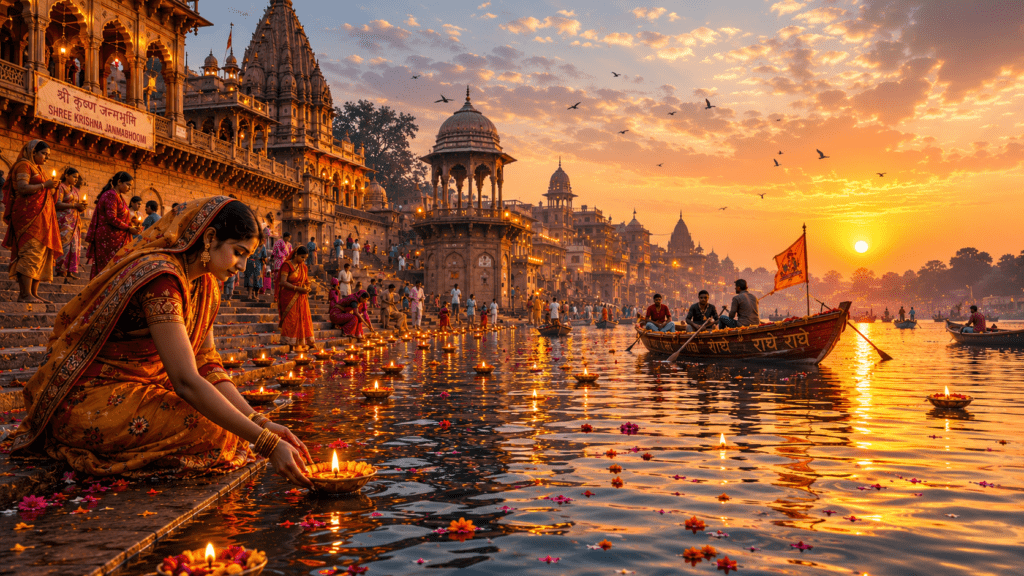
The most captivating, spiritually uplifting daily event at Vishram Ghat is the Yamuna Aarti, a deeply moving ritual that transforms the riverbank into a celestial spectacle every evening.
As the sun dips below the horizon, priests dressed in pristine traditional attire stand upon the steps, moving massive, multi-tiered brass oil lamps in rhythmic, circular motions. The air grows thick with the intoxicating fragrance of incense, while the rhythmic beating of massive drums, the clanging of cymbals, and the chanting of ancient Vedic hymns resonate across the water.
The Restoration of the Sacred Kunds
Beyond the river, the hydrology of Braj is defined by its Kunds—ancient, stepped water bodies that act as reservoirs of both water and spiritual history. In recent years, a massive ecological and spiritual restoration effort has taken place across the region. Over 36 historical Kunds have been protected, desilted, and beautifully preserved.
These Kunds, many of which were on the brink of ecological extinction due to neglect, have been revived through the inspiration of local saints and the efforts of organizations like the Maan Mandir Trust.
The Living Theology: Festivals and Cosmic Celebrations
Mathura does not merely observe festivals as historical commemorations; it lives them as present realities. The calendar of Braj is an unbroken, cyclical mandala of divine remembrance, where the events of the distant Dvapara-yuga are recreated and relived by millions of devotees with an emotional intensity that utterly defies the passage of time.
Shri Krishna Janmashtami: The Descent of the Divine
Janmashtami, the grand celebration of Lord Krishna’s birth, is the absolute pinnacle of Mathura’s spiritual year. Falling on the eighth day (ashtami) of the dark fortnight in the month of Bhadrapada (typically overlapping with August or September in the Gregorian calendar), this festival draws global attention and millions of pilgrims.
The rituals associated with Janmashtami are deeply symbolic, psychologically demanding, and physically rigorous. Devotees observe a strict, absolute fast (upavasa) throughout the entire day, often refraining from both food and water.
The absolute climax of the festival occurs at the exact stroke of midnight, the sacred Nishita window. Astrologically and theologically, this represents the exact moment of the divine descent into the darkness of material existence to dispel ignorance.
Following the purifying bath, the deity is meticulously dressed in fresh, bright yellow silk (pītāmbara), adorned with precious jewels, a flute (bansuri), and peacock feathers, and then placed into a beautifully decorated, flower-laden swinging cradle for the Jhulan (swinging) ceremony, welcoming the newborn Lord.
The Unmatched Exuberance of Mathura Holi
While the rest of the Indian subcontinent celebrates Holi for a single day, in Mathura and the wider Braj region, Holi is a prolonged, 40-day cultural phenomenon that seamlessly blends ecstatic devotion with unparalleled sensory joy.
The Braj Holi schedule is a highly structured, moving carousel of events across different towns, each day offering a unique flavor of celebration
| Festival Date / Phase | Event & Location | Cultural & Theological Significance |
| Barsana Lathmar Holi | Barsana (Town of Radha) | A playful, highly energetic, and physically intense reenactment of gender dynamics. The women of Barsana wield large bamboo sticks (lath) to playfully beat the shield-bearing men visiting from Nandgaon, recreating the ancient, loving rivalry between Krishna and Radha’s respective villages. |
| Nandgaon Holi | Nandgaon (Town of Krishna) | The exact reversal of the previous day; the women of Barsana travel to Nandgaon to take their revenge, throwing color and playing Holi with the local men in a joyous display of communal harmony. |
| Phoolon Ki Holi | Banke Bihari Temple, Vrindavan | Hosted on Rangbhari Ekadashi, this is a delicate, magical, and highly spiritual event. Instead of harsh colored powder, priests and devotees play Holi by showering each other exclusively with tons of fresh, fragrant flower petals, creating a breathtaking visual and olfactory experience. |
| Gokul Holi & Raman Reti | Gokul | Festivities shift to the soft sands of Gokul, celebrating the childhood pranks of toddler Krishna. Devotees play in the sand and seek blessings in the very dust where Krishna crawled. |
| Holika Dahan | Vishram Ghat & Across the City | The burning of massive bonfires to symbolize the ultimate victory of good over evil, accompanied by a grand, traditional procession (Dola) emerging from the Dwarkadhish Temple. |
| Dhulandi (Main Holi) | Dwarkadhish Temple, Mathura | The spectacular, chaotic climax of the 40-day festival. The Dwarkadhish Temple becomes the epicenter of a massive color-throwing ritual. Devotees use specific organic, wet colors derived from Tesu flowers, drenching the temple courtyard in a sea of vibrant yellows, pinks, and reds, accompanied by deafening dhol beats and uninhibited ecstatic dancing. |
Yama Dwitiya (Bhai Dooj): The Festival of Eternal Sibling Devotion
While Janmashtami and Holi are inherently centered around the figure of Lord Krishna, Yama Dwitiya (commonly known across North India as Bhai Dooj) is a deeply emotional, highly specific festival centered around the sacred Yamuna River and the unbreakable bonds of familial, sibling love.
The festival is rooted in a profound, touching Puranic legend. It is said that Goddess Yamuna persistently invited her twin brother, Yama (the feared God of Death and Justice), to her home for a meal. Because of his heavy, unyielding cosmic duties judging the souls of the dead and maintaining cosmic balance, Yama was constantly delayed. Finally, finding a moment of respite, he visited her at the banks of the river. Overjoyed, Yamuna prepared a magnificent feast and placed a protective tilak on his forehead to shield him from negativity.
Deeply touched by her pure, unwavering sisterly affection—a love that transcended his terrifying cosmic role—Yama offered her any boon she desired. Selfless in her nature, Yamuna asked for no material wealth or cosmic power; she simply requested that her ghats be radiant with the presence of brothers and sisters every year on this day, and that any siblings who bathe in her waters together be permanently spared from the fear of death and the torments of hell.
Today, this ancient, divine promise draws hundreds of thousands of sibling pairs to Vishram Ghat.
The Culinary Prasadam: The Spiritual Alchemy of Mathura Ke Pede
The spiritual experience of Mathura does not end at the temple exit; it extends seamlessly into its rich culinary traditions. Just as the city’s architecture and festivals are entirely devoted to Krishna, so too is its gastronomy.
While the city offers numerous delicacies, such as spicy Dookbiwale Aloo and sweet Malai Lassi, the undisputed, globally recognized crown jewel of this culinary heritage is the Mathura Peda.
The creation of an authentic Mathura Peda is an exercise in immense culinary patience and devotion. Unlike standard pedas found elsewhere in India—which are typically light cream in color, soft, and mildly sweet—the Mathura Peda is distinctively rich, deeply caramelized, and light to dark brown in hue.
Once shaped into irregular, rustic rounds by hand, the peda is generously infused with freshly ground cardamom (ilaichi) for a fragrant lift, and then rolled in boora or tagar (a coarse, unrefined powdered sugar).
The cultural and religious significance of the Mathura Peda cannot be overstated. It is an essential, mandatory offering at temple altars across the city, particularly during massive festivals like Janmashtami and Holi, where it is first presented to the deities to be blessed, and then distributed to the masses of devotees.
Conclusion: The Eternal Resonance of Mathura
To attempt to understand Mathura through the sterile lens of mere secular history or physical geography is to miss its essence entirely. Mathura operates as an interactive, living mandala, a space where the divine continuously intersects with the mundane. Every stone and brick in the heavily fortified Shri Krishna Janmasthan Temple complex speaks volumes of centuries of resilience, an unyielding faith that refused to be extinguished by the swords of invaders or the passing of empires.
The city’s theology is remarkably advanced. The synthesis of Shaiva protection via the four Dik-palas with intense Vaishnava devotion demonstrates a harmonious religious ecosystem that embraces the entirety of the cosmic order, proving that all paths of true devotion ultimately support one another.
Mathura is a city where the boundary between the material and the spiritual is intentionally, beautifully porous. It is a sacred geography where mythology is not viewed as a relic of a forgotten past, but as a daily, lived reality that dictates the rhythm of life, the calendar of the year, and the beating of the human heart. For the sincere seeker, the academic, and the pilgrim alike, Mathura is not simply a destination on a map; it is the ultimate homecoming of the soul, a place where the divine play of the Supreme Lord continues to echo through eternity.