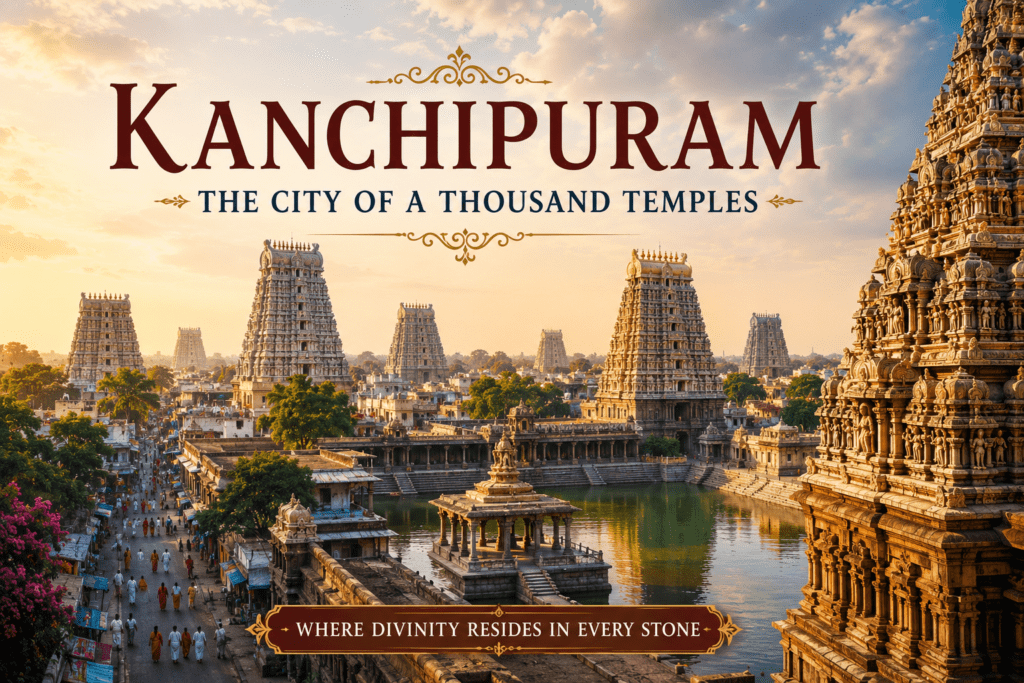
Nestled on the banks of the sacred Vegavathi River in Tamil Nadu, Kanchipuram stands as one of the most revered pilgrimage destinations in all of India. Known by many glorious names — Kanchi, the City of a Thousand Temples, Shiva Vishnu Kanchi, and one of the Sapta Puri (the Seven Sacred Cities of Hinduism) — this ancient city is a living testament to the unbroken flow of spiritual tradition, devotion, and divine grace spanning more than two millennia.
For the devout Hindu pilgrim, setting foot in Kanchipuram is itself an act of liberation. Ancient scriptures and sages have declared that the mere darshan of this city — simply beholding it — is enough to wash away the accumulated karma of countless lifetimes. This is not mere legend; it is a living conviction shared by millions who have walked these sacred streets, bathed in its temple tanks, and prostrated before its magnificent deities.
Among all sacred places, Kanchipuram shines most gloriously. A single day of residence here equals the merit of performing ten thousand Ashwamedha yajnas.
— Skanda Purana
Whether you are a devoted pilgrim seeking the blessings of Lord Shiva, a devotee of Lord Vishnu yearning for moksha, or a seeker drawn to the powerful presence of Adi Shakti, Kanchipuram welcomes all. It is the rare and blessed city that is simultaneously home to Shiva Kanchi, Vishnu Kanchi, and Shakti temples — a place where the three great streams of Hindu devotion flow together in harmony and wholeness.
Mythological Significance: Born of the Divine
Brahma’s Sacred Creation
According to Hindu mythology, Kanchipuram was created by Lord Brahma himself. It is said that after performing a great yajna (sacrifice), Brahma was asked by the other gods where he would establish his earthly abode. He chose the spot where the present-day Kamakshi Amman Temple stands, declaring that this spot would forever be a place of supreme spiritual power.
Another legend tells us that Goddess Parvati, wishing to understand the nature of Lord Shiva’s supremacy, playfully covered His eyes with her palms — inadvertently plunging the universe into darkness. As penance, She came to Kanchipuram and performed intense austerities under a mango tree, meditating upon a Shivalinga fashioned from sand — a Prithvi Linga (the earth element). Moved by Her devotion, Lord Shiva appeared and accepted Her as His equal and consort. This is why Kamakshi — She whose eyes are full of love — presides here with absolute sovereignty.
The great sage and philosopher Adi Shankaracharya visited Kanchipuram in the 8th century CE and was so overwhelmed by the ferocity of the Goddess’s power that he installed a Sri Chakra at the feet of Kamakshi to stabilize and channel her divine energy for the benefit of all devotees. To this day, Sri Kamakshi is worshipped in the Saumya (gentle, benevolent) form — the supreme mother who grants all wishes, dispels all fears, and leads her children to liberation.
The Wrestling Match of Lord Shiva: The Ekambareshwara Legend
The story behind the celebrated Ekambareshwara Temple is one of the most beloved legends of South India. The presiding deity is Lord Shiva in the form of Ekambareshwara (Lord of the Mango Tree), representing the Prithvi (Earth) element among the Pancha Bhuta Stalas — the five sacred abodes of Shiva corresponding to the five elements of creation.
According to the Sthala Purana, when Lord Shiva tested Goddess Parvati by sending floods to disrupt her tapas (austerities), she hugged the Shivalinga tightly to protect it. Pleased by her devotion, Lord Shiva appeared and merged with her in this sacred spot, blessing the earth itself as the lingam. The ancient mango tree under which Parvati meditated is still worshipped within the temple complex today — believed to be over 3,500 years old.
The Five Sacred Zones: Pancha Kanchi
The five sacred zones of Kanchipuram, known as the Pancha Kanchi, represent the completeness of spiritual life:
- Shiva Kanchi: The northern zone dedicated to Lord Shiva, home to the magnificent Ekambareshwara, Kailasanathar, and Kamakoteeswara temples.
- Vishnu Kanchi — The southern zone sacred to Lord Vishnu, anchored by the great Varadaraja Perumal Temple and the Ulagalanda Perumal Temple.
- Shakti Kanchi — Centered on the Kamakshi Amman Temple, radiating the supreme energy of the Divine Mother across the entire city.
This unique tripartite identity makes Kanchipuram a microcosm of the entire Hindu spiritual universe — a microcosm where the three great currents of Shaivism, Vaishnavism, and Shakti worship converge in perfect harmony.
The Great Temples of Kanchipuram
1. Ekambareshwara Temple — The Earth Linga
Standing as one of the largest temples in India, the Ekambareshwara Temple covers an area of over 25 acres and soars to a height of 59 meters with its magnificent Rajagopuram (royal gateway tower). Built and expanded over centuries by Pallava, Chola, and Vijayanagara kings, this temple represents the Prithvi (Earth) element among the Pancha Bhuta Stalas of Lord Shiva.
The presiding deity is Ekambareshwara (Shiva) and Elavarkuzhali (Parvati). The highlight of this temple is the ancient multi-rooted mango tree in the courtyard, revered as the Sthala Vriksha (sacred tree of the temple), said to be over 3,500 years old. Pilgrims believe that each of its four branches yields mangoes of distinct flavor, representing the four Vedas.
The thousand-pillared hall within the temple is a masterpiece of Dravidian architecture, each pillar exquisitely carved with scenes from the epics and scenes of divine life.
2. Kamakshi Amman Temple — The Throne of the Goddess
The Kamakshi Amman Temple is perhaps the most spiritually charged site in all of Kanchipuram. The main shrine houses the golden idol of Kamakshi seated in padmasana (lotus posture) — a rare and significant form, for unlike most fierce goddess manifestations, Kamakshi here is seated in meditative tranquility, radiating supreme maternal compassion.
The temple is renowned for the special puja performed with the Sri Chakra — a geometric mandala representing the entire cosmos and the divine feminine energy. Devotees believe that praying before Kamakshi grants all four Purusharthas: Dharma (righteousness), Artha (prosperity), Kama (desire), and Moksha (liberation). The annual Brahmotsavam festival draws hundreds of thousands of pilgrims to this sacred shrine.
3. Varadaraja Perumal Temple — The Emperor of Vishnu Kanchi
Built primarily by the Vijayanagara kings in the 12th–16th centuries, the Varadaraja Perumal Temple is an architectural marvel spanning 23 acres. The presiding deity, Lord Varadaraja, appears in a reclining (shayana) posture, radiating divine serenity.
The 100-pillared hall within the temple is celebrated as one of the finest examples of Vijayanagara art — each pillar carved with exquisite warriors, celestial beings, and mythological scenes. Every 40 years, the temple performs a rare ritual called the Sahasra Pushpabhishekam for the wooden idol of Athi Varadar — a special form of Vishnu made from a fig tree kept in a sacred tank. The idol is brought out for 48 days of public darshan — an event that draws millions of pilgrims, as it is considered extraordinarily auspicious to behold this form of the Lord.
4. Kailasanathar Temple — The Oldest Jewel
The Kailasanathar Temple holds the distinction of being the oldest standing structure in Kanchipuram, built in the early 8th century CE by the Pallava king Rajasimha (Narasimhavarman II). Unlike the towering Dravidian temples of later centuries, the Kailasanathar Temple has an intimate, almost meditative quality — its honey-golden sandstone radiating a timeless warmth.
The temple’s outer wall is adorned with 58 small shrines, each containing a different form of Lord Shiva. The interior reveals stunning Pallava frescoes — some of the oldest painted murals in South India — and the main shrine contains a magnificent Shivalinga. Pilgrims devotionally crawl through a narrow tunnel around the sanctum as an act of surrender and rebirth. This temple is a UNESCO-recognized heritage monument and a living spiritual treasure.
5. Ulagalanda Perumal Temple — Where Vishnu Measured the Universe
This celebrated Divya Desam temple commemorates the avatar of Lord Vishnu as Vamana — the dwarf Brahmin who measured the universe in three steps. The presiding deity appears as Trivikrama in a magnificent pose with one foot raised skyward.
The Alvar saints have sung ecstatically about this temple in their Divya Prabandham hymns, and pilgrims who visit here are said to receive the blessings of all 108 Divya Desams.
Among the Sapta Puri: The Seven Sacred Cities
Hindu tradition recognizes seven cities — the Sapta Puri — whose very darshan is believed to bestow moksha (liberation from the cycle of birth and death). Kanchipuram stands alongside Ayodhya, Mathura, Haridwar, Varanasi, Ujjain, and Dwarka as one of these supreme tirthas (pilgrimage places).
The Garuda Purana and several other sacred texts explicitly name Kanchipuram as a place where dying is itself a doorway to liberation.
Ayodhya Mathura Maya Kashi Kanchi Avantika, Puri Dwaraka chaiva Saptaite Mokshadayikah — These seven sacred cities grant liberation to those who dwell in them.
What makes Kanchipuram unique even among the Sapta Puri is its remarkable dual identity — it is both Shiva Kanchi and Vishnu Kanchi, sacred equally to Shaivites and Vaishnavas. The city thus transcends sectarian boundaries and stands as a symbol of the unity underlying all Hindu devotion. Here, the devotee of Shiva and the devotee of Vishnu walk the same sacred streets, drink from the same holy wells, and breathe the same spiritually charged air.
The Sages and Spiritual Giants of Kanchi
Adi Shankaracharya — The Philosopher of Non-Duality
Kanchipuram holds a special place in the life and mission of Adi Shankaracharya, the 8th-century philosopher-saint who revitalized Hinduism through his Advaita Vedanta (non-dualism) philosophy. Shankaracharya visited Kanchipuram and is believed to have been profoundly transformed by his encounter with Kamakshi Amman. He established the Kanchi Kamakoti Peetham — one of the four great monastic institutions (mathas) of the Advaita tradition — in this city. The Kanchi Kamakoti Peetham has continued as an unbroken spiritual lineage, with successive Shankaracharyas serving as the spiritual guides of millions.
Kanchi Mahaswami — The Walking God
Sri Chandrasekharendra Saraswati, the 68th Shankaracharya of the Kanchi Kamakoti Peetham, is revered by millions as a living embodiment of divinity. For over a century, he walked barefoot across India, never using motorized transport, preserving ancient Vedic traditions, performing yajnas, and dispensing wisdom and blessings to the rich and poor alike. Prime Minister Jawaharlal Nehru, Nobel laureate C.V. Raman, and countless others sought his counsel and blessings.
His samadhi (sacred resting place) is enshrined at the Kanchi Kamakoti Peetham, and devotees report experiencing profound peace and divine presence when they sit in meditation there. The Mahaswami continues to be a living spiritual force in the city, and his teachings on Dharma, the Vedas, and the sanctity of traditional life remain a guiding light for countless seekers.
A Pilgrim’s Guide to Kanchipuram
How to Reach Kanchipuram
- By Air: The nearest major airport is Chennai International Airport (75 km). Regular flights operate from all major Indian cities.
- By Rail: Regular trains run between Chennai Egmore and Kanchipuram. The journey takes about 1.5 hours.
- By Road: Kanchipuram is well-connected by road to Chennai (75 km, ~1.5 hours) and other cities in Tamil Nadu. Buses and private vehicles are readily available.
Best Time to Visit
Kanchipuram can be visited throughout the year, but the months of October to March (post-monsoon and winter) are most pleasant in terms of climate. Festival seasons — particularly Brahmotsavam months — offer the richest devotional atmosphere but also the largest crowds. For those seeking quiet contemplation, early morning visits on weekdays outside festival seasons offer a profoundly peaceful experience.
Pilgrimage Etiquette and Customs
- Observe traditional dress codes: dhoti for men and saree or churidar for women when entering the main temples.
- Footwear must be removed outside all temple premises.
- The inner sanctums of major temples require the upper body to be uncovered for men.
- It is considered auspicious to recite the names of the deity (namasankirtana) while waiting in the darshan queue — this transforms even the waiting into a form of meditation and spiritual practice.
- Many devotees carry fresh flowers, coconuts, and camphor as offerings.
Festivals of Kanchipuram
- Panguni Uthram (March-April): The grand annual Brahmotsavam festival at the Kamakshi Amman Temple, featuring grand processions of the goddess on various vahanas (vehicles).
- Aadi Pooram (July-August): Celebrated with special grandeur at Kamakshi Amman Temple — the divine birthday of the Goddess.
- Chithirai Brahmotsavam (April-May): The grand festival at Varadaraja Perumal Temple, featuring the spectacular procession of the deity on different vahanas.
- Athi Varadar Festival (once every 40 years): One of the rarest and most sought-after spiritual events in South India. The wooden idol of Athi Varadar is brought out for 48 days of public darshan.
- Float Festival (Teppotsavam): The deity is taken on a decorated boat in the temple tank, accompanied by devotional music and prayers.
How to Prepare for the Pilgrimage
Traditional pilgrimage etiquette recommends observing a day of fasting or light sattvic diet before visiting Kanchipuram. Pilgrims are expected to wear traditional attire — dhoti for men and saree or churidar for women — when entering the main temples.
Footwear must be removed outside all temple premises. The inner sanctums of major temples require the upper body to be uncovered for men. It is considered auspicious to recite the names of the deity (namasankirtana) while waiting in the darshan queue — this transforms even the waiting into a form of meditation and spiritual practice.
Sacred Silk: The Living Tradition of Kanchipuram Sarees
No account of Kanchipuram is complete without mention of its world-famous Kanjivaram (Kanchipuram) silk sarees — a tradition that is itself a form of spiritual offering. Woven with pure mulberry silk and pure gold or silver zari thread, these sarees take weeks to create.
Many traditional weaver families begin their work each morning with prayer and consider their art a form of devotion to the divine. A Kanchipuram saree offered to the deity as vastra (sacred clothing) is considered among the most precious of all temple offerings. Pilgrims often purchase a saree in Kanchipuram itself to drape around the idol of their home deity — carrying a little of this sacred city’s grace back with them into everyday life.
Why Kanchipuram Transforms the Soul
What is it about Kanchipuram that has drawn saints, seekers, poets, and pilgrims for thousands of years? Beyond the magnificence of its temples and the richness of its mythology, there is something subtler and more profound at work — a vibration, a shakti, that permeates the very air and soil of the city.
The Vedic and Agamic traditions teach that certain geographical locations on earth are more spiritually charged than others — places where the veil between the visible and invisible worlds is thin, where the divine is more accessible, where prayers carry extra potency. Kanchipuram is one such place. The concentrated devotion of countless saints, sages, and pilgrims over thousands of years has charged this city with an extraordinary spiritual field — what the yogic tradition calls a tapobhumi (land of austerity and spiritual power).
Pilgrims consistently report that something shifts within them when they visit Kanchipuram — a quieting of the restless mind, a softening of the heart, a deeper sense of connection to the divine. Cynics become contemplative, the grief-stricken find comfort, and the spiritually seeking find clarity. This is the gift of Kanchipuram: it meets every devotee exactly where they are and offers precisely what they need.
In Kanchipuram, the divine does not wait in temples alone — it walks the streets, breathes in the air, and dwells in the eyes of those who come with open hearts.
A Final Reflection: Return to the Source
To visit Kanchipuram is not merely to see ancient temples or touch old stones. It is to step into a living current of divine grace that has flowed uninterrupted for more than two thousand years. It is to join the vast river of seekers — kings and beggars, scholars and simpletons, the grief-stricken and the joyful — who have all come to this sacred city and found what they were looking for: not outside themselves, but within, reflected in the compassionate eyes of Kamakshi, the serene gaze of Varadaraja, and the formless presence of Ekambareshwara.
The Vedas declare Aham Brahmasmi — I am Brahman, the ultimate reality. Kanchipuram, with its thousands of temples, its ancient wisdom, and its living spiritual traditions, exists as a grand outer reminder of this eternal inner truth.
Come here not just as a tourist or a pilgrim, but as a soul yearning to remember what it has always known — that the divine is not distant, not hidden, not inaccessible. It is here. It is now. It is you.
The city of Kanchi is not merely a place on the map. It is a doorway in consciousness — a sacred threshold through which the ordinary becomes extraordinary, the mortal touches the immortal, and the seeking soul finds its way home.
— Sri Chandrasekharendra Saraswati, Kanchi Mahaswami
Sacred Mantras and Prayers
Om Namah Shivaya
Om Namo Narayanaya
Om Aim Hreem Shreem Kamakshyai Namaha
These sacred mantras are the essence of Kanchipuram’s spiritual essence — invoking the divine energies of Shiva, Vishnu, and the Divine Mother Kamakshi. Reciting these mantras with devotion is believed to purify the mind, purify the heart, and draw the devotee closer to the divine presence that permeates every corner of this sacred city.
Return to the Source: A Closing Reflection
To visit Kanchipuram is not merely to see ancient temples or touch old stones. It is to step into a living current of divine grace that has flowed uninterrupted for more than two thousand years. It is to join the vast river of seekers — kings and beggars, scholars and simpletons, the grief-stricken and the joyful — who have all come to this sacred city and found what they were looking for: not outside themselves, but within, reflected in the compassionate eyes of Kamakshi, the serene gaze of Varadaraja, and the formless presence of Ekambareshwara.
The Vedas declare Aham Brahmasmi — I am Brahman, the ultimate reality. Kanchipuram, with its thousands of temples, its ancient wisdom, and its living spiritual traditions, exists as a grand outer reminder of this eternal inner truth.
Come here not just as a tourist or a pilgrim, but as a soul yearning to remember what it has always known — that the divine is not distant, not hidden, not inaccessible. It is here. It is now. It is you.
The city of Kanchi is not merely a place on the map. It is a doorway in consciousness — a sacred threshold through which the ordinary becomes extraordinary, the mortal touches the immortal, and the seeking soul finds its way home.
— Sri Chandrasekharendra Saraswati, Kanchi MahaswamiThe Five Sacred Kanchis: Pancha Kanchi
Ancient tradition divides Kanchipuram into five distinct sacred zones, each associated with a different divine energy and form of worship. Together they form the Pancha Kanchi, representing the completeness of spiritual life:
- Shiva Kanchi: The northern zone dedicated to Lord Shiva, home to the magnificent Ekambareshwara, Kailasanathar, and Kamakoteeswara temples.
- Vishnu Kanchi: The southern zone sacred to Lord Vishnu, anchored by the great Varadaraja Perumal Temple and the Ulagalanda Perumal Temple.
- Jaina Kanchi: The zone associated with Jain sacred spaces, reflecting the ancient religious pluralism of this city.
- Buddha Kanchi: Historically linked to Buddhist presence — Kanchipuram was once a great center of Buddhist learning.
- Shakti Kanchi: Centered on the Kamakshi Amman Temple, radiating the supreme energy of the Divine Mother across the
Sacred Mantras and Prayers
Om Namah Shivaya
Om Namo Narayanaya
Om Aim Hreem Shreem Kamakshyai NamahaThese sacred mantras are the essence of Kanchipuram’s spiritual essence — invoking the divine energies of Shiva, Vishnu, and the Divine Mother Kamakshi. Reciting these mantras with devotion is believed to purify the mind, purify the heart, and draw the devotee closer to the divine presence that permeates every corner of this sacred city.
Why Kanchipuram Transforms the Soul
What is it about Kanchipuram that has drawn saints, seekers, poets, and pilgrims for thousands of years? Beyond the magnificence of its temples and the richness of its mythology, there is something subtler and more profound at work — a vibration, a shakti, that permeates the very air and soil of the city.
The Vedic and Agamic traditions teach that certain geographical locations on earth are more spiritually charged than others — places where the veil between the visible and invisible worlds is thin, where the divine is more accessible, where prayers carry extra potency. Kanchipuram is one such place. The concentrated devotion of countless saints, sages, and pilgrims over thousands of years has charged this city with an extraordinary spiritual field — what the yogic tradition calls a tapobhumi (land of austerity and spiritual power).
The Pilgrim’s Guide: Practical Wisdom for the Sacred Journey
How to Reach Kanchipuram
Kanchipuram is located approximately 75 kilometers southwest of Chennai (Madras) in Tamil Nadu. It is well connected by road and rail. The most convenient route is by road from Chennai — a journey of about 1.5 to 2 hours by car or bus. The nearest major airport is Chennai International Airport. Regular trains run between Chennai Egmore and Kanchipuram. Many devotees also combine Kanchipuram with a pilgrimage to Tirupati (Lord Venkateswara) and Tiruvannamalai (Lord Arunachaleswara) as part of a sacred South India pilgrimage circuit.
Festivals of Kanchipuram
- Panguni Uthram (March-April): The grand annual Brahmotsavam festival at the Kamakshi Amman Temple, featuring grand processions of the goddess on various vahanas (vehicles).
- Aadi Pooram (July-August): Celebrated with special grandeur at Kamakshi Amman Temple — the divine birthday of the Goddess.
- Brahmotsavam (April-May): The grand 16-day festival at Varadaraja Perumal Temple, featuring elaborate processions and rituals.
- Athi Varadar Festival (once every 40 years): One of the rarest and most sought-after spiritual events in South India. The wooden idol of Athi Varadar is brought out for 48 days of public darshan.
- Aadi Pooram (July-August): Celebrated with special grandeur at Kamakshi Amman Temple — the divine birthday of the Goddess.
Pilgrimage Etiquette and Customs
Traditional pilgrimage etiquette recommends observing a day of fasting or light sattvic diet before visiting Kanchipuram. Pilgrims are expected to wear traditional attire — dhoti for men and saree or churidar for women — when entering the main temples.
Footwear must be removed outside all temple premises. The inner sanctums of major temples require the upper body to be uncovered for men. It is considered auspicious to recite the names of the deity (namasankirtana) while waiting in the darshan queue — this transforms even the waiting into a form of meditation and spiritual practice. Many devotees carry fresh flowers, coconuts, and camphor as offerings. The simplest and most powerful offering, however, is one’s own heart — offered with complete surrender and gratitude.
Why Kanchipuram Transforms the Soul
What is it about Kanchipuram that has drawn saints, seekers, poets, and pilgrims for thousands of years? Beyond the magnificence of its temples and the richness of its mythology, there is something subtler and more profound at work — a vibration, a shakti, that permeates the very air and soil of the city.
The Vedic and Agamic traditions teach that certain geographical locations on earth are more spiritually charged than others — places where the veil between the visible and invisible worlds is thin, where the divine is more accessible, where prayers carry extra potency. Kanchipuram is one such place. The concentrated devotion of countless saints, sages, and pilgrims over thousands of years has charged this city with an extraordinary spiritual field — what the yogic tradition calls a tapobhumi (land of austerity and spiritual power).
The Pilgrim’s Experience: Voices Across Time
Across centuries, poets, saints, philosophers, and ordinary devotees have left behind testimonies of the transformative power of Kanchipuram. The Alvars — the twelve great Vaishnava poet-saints of South India — composed ecstatic hymns about Kanchi. The Nayanars — the 63 Shaivite saint-poets — sang the glory of the Shiva temples here with ecstatic devotion.
Adi Shankaracharya established his southern Matha (monastery) at Kanchipuram, recognizing its supreme spiritual potency. The great poet-saint Thirumangai Alvar and the Nayanars — the 63 Shaivite saints — all sang the praises of Kanchi’s divine glory. The medieval saint-poet Ramalinga Swamigal (Vallalar) was deeply connected to the Kanchi tradition, and his life and songs reflect the essence of what Kanchi represents — a heart open to the Divine, a life lived in loving service, and the complete surrender that transforms even the humblest person into a vessel of grace.
The Pilgrim’s Guide: Practical Wisdom for the Sacred Journey
Best Time to Visit
Kanchipuram can be visited throughout the year, but the months of October to March (post-monsoon and winter) are most pleasant in terms of climate. Festival seasons — particularly Brahmotsavam months — offer the richest devotional atmosphere but also the largest crowds. For those seeking quiet contemplation, early morning visits on weekdays outside festival seasons offer a profoundly peaceful experience.
How to Reach Kanchipuram
Kanchipuram is located approximately 75 kilometers southwest of Chennai (Madras) in Tamil Nadu. It is well connected by road and rail. The most convenient route is by road from Chennai — a journey of about 1.5 to 2 hours by car or bus. The nearest major airport is Chennai International Airport. Regular trains run between Chennai Egmore and Kanchipuram. Many devotees also combine Kanchipuram with a pilgrimage to Tirupati (Lord Venkateswara) and Tiruvannamalai (Lord Arunachaleswara) as part of a sacred South India pilgrimage circuit.
Best Time to Visit
Kanchipuram can be visited throughout the year, but the months of October to March (post-monsoon and winter) are most pleasant in terms of climate. Festival seasons — particularly Brahmotsavam months — offer the richest devotional atmosphere but also the largest crowds. For those seeking quiet contemplation, early morning visits on weekdays outside festival seasons offer a profoundly peaceful experience.
Pilgrimage Etiquette and Customs
Traditional pilgrimage etiquette recommends observing a day of fasting or light sattvic diet before visiting Kanchipuram. Pilgrims are expected to wear traditional attire — dhoti for men and saree or churidar for women — when entering the main temples. Footwear must be removed outside all temple premises.
The inner sanctums of major temples require the upper body to be uncovered for men. It is considered auspicious to recite the names of the deity (namasankirtana) while waiting in the darshan queue — this transforms even the waiting into a form of meditation and spiritual practice. Many devotees carry fresh flowers, coconuts, and camphor as offerings. The simplest and most powerful offering, however, is one’s own heart — offered with complete surrender and gratitude.
Sacred Silk: The Living Tradition of Kanchipuram Sarees
No account of Kanchipuram is complete without mention of its world-famous Kanjivaram (Kanchipuram) silk sarees — a tradition that is itself a form of spiritual offering. Woven with pure mulberry silk and pure gold or silver zari thread, these sarees take weeks to create.
Many traditional weaver families begin their work each morning with prayer and consider their art a form of devotion to the divine. A Kanchipuram saree offered to the deity as vastra (sacred clothing) is considered among the most precious of all temple offerings. Pilgrims often purchase a saree in Kanchipuram itself to drape around the idol of their home deity — carrying a little of this sacred city’s grace back with them into everyday life.
Return to the Source: A Closing Reflection
To visit Kanchipuram is not merely to see ancient temples or touch old stones. It is to step into a living current of divine grace that has flowed uninterrupted for more than two thousand years. It is to join the vast river of seekers — kings and beggars, scholars and simpletons, the grief-stricken and the joyful — who have all come to this sacred city and found what they were looking for: not outside themselves, but within, reflected in the compassionate eyes of Kamakshi, the serene gaze of Varadaraja, and the formless presence of Ekambareshwara.
The Vedas declare Aham Brahmasmi — I am Brahman, the ultimate reality. Kanchipuram, with its thousands of temples, its ancient wisdom, and its living spiritual traditions, exists as a grand outer reminder of this eternal inner truth.
Come here not just as a tourist or a pilgrim, but as a soul yearning to remember what it has always known — that the divine is not distant, not hidden, not inaccessible. It is here. It is now. It is you.
Om Namah Shivaya
Om Namo Narayanaya
Om Aim Hreem Shreem Kamakshyai NamahaThis article was written for spiritual seekers and devotees. May it inspire a pilgrimage — outer or inner — to the sacred city of Kanchipuram.