🕉 Dwarka 🕉
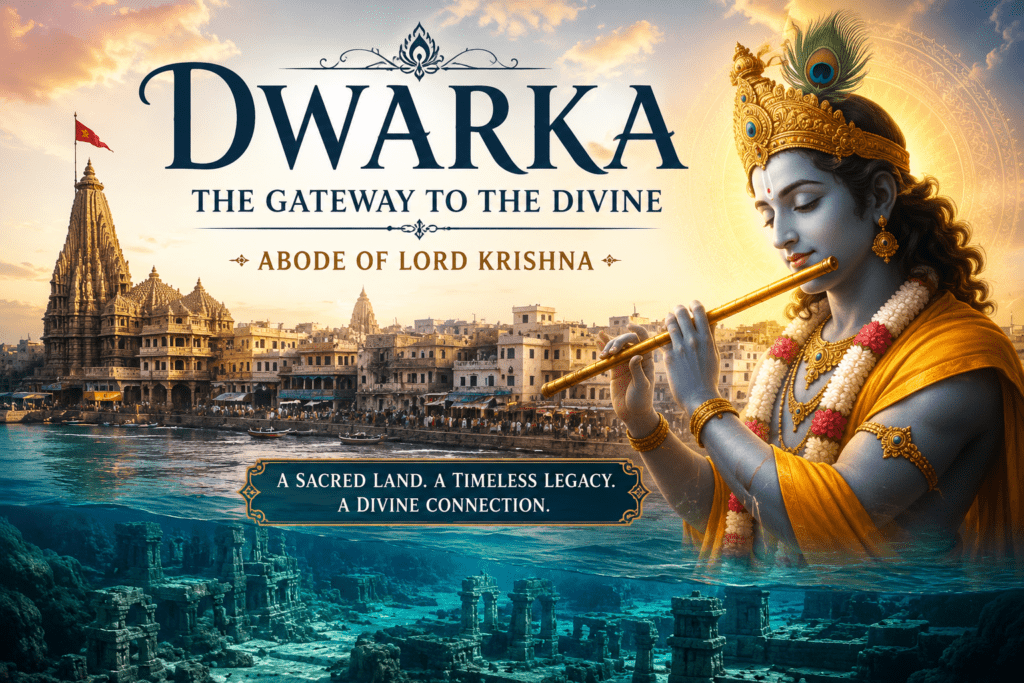
The Gateway to the Divine — Abode of Lord Krishna
Published on ridhyaspiritual.com
"Where the ocean kisses the sacred earth and eternity meets the mortal world — there stands Dwarka, the City of God."
In the vast spiritual geography of Bharat (India), few places carry the weight of divine memory, cosmic legend, and living faith as profoundly as Dwarka. Nestled on the westernmost tip of Gujarat, where the turbulent waters of the Arabian Sea meet the ancient landmass of the Saurashtra peninsula, Dwarka is not merely a city — it is a testimony to the eternal presence of Lord Sri Krishna, the Supreme Personality of Godhead.
For millions of devotees across the world, Dwarka represents the ultimate sacred destination — one of the Char Dham (four divine abodes) that every devout Hindu aspires to visit in their lifetime. It is a place where mythology breathes through stone, where prayers have echoed for millennia, and where the very soil is considered drenched in divine consciousness.
This article is an offering — a humble attempt to bring you closer to the glory, mystery, history, and spiritual significance of Dwarka. Whether you are a devoted pilgrim, a curious seeker, or someone drawn to the rich tapestry of Sanatan Dharma, we invite you to journey with us through this sacred city.
The Name Dwarka: A City Etched in Eternity
The very name "Dwarka" is laden with profound spiritual meaning. In Sanskrit, the word is derived from two roots:
✦ Dwar (द्वार) — meaning Gate or Door
✦ Ka (क) — referring to Brahman, the Supreme Absolute, or Moksha (liberation)
Together, Dwarka means "The Gateway to Brahman" or "The Door to Moksha." It is the city through which the soul may pass from the realm of illusion (Maya) into the realm of divine truth and liberation. This is not a metaphor — for thousands of years, spiritual seekers have experienced transformations of the deepest kind upon setting foot in this sacred land.
The city has been known by many names across the ages: Dwaraka, Dwarravati, Kushsthali, Okha, and Jagat (meaning the city of the universe). Each name holds a chapter of its glorious story. The Mahabharata refers to it as Dvaravati — the city adorned with many gates — suggesting a metropolis of unimaginable architectural splendor.
Where Heaven Meets Earth: The Sacred Geography of Dwarka
Dwarka is located in the Devbhoomi Dwarka district of Gujarat, at the tip of the Kathiawar Peninsula (Saurashtra), where the Gomti River meets the Arabian Sea. This geographical position — at the confluence of river and ocean — is itself considered highly auspicious in the Vedic tradition. The meeting of fresh water and salt water (Sangam) is traditionally regarded as a place of exceptional spiritual potency.
The coastline here is dramatic and evocative. On one side, the majestic Dwarkadhish Temple rises above the city, its five-storey spire (shikhara) soaring 51.8 meters into the sky, visible to pilgrims arriving by sea or land. On the other side, the ocean stretches infinitely — a perpetual reminder of the boundless nature of the Divine.
The Submerged City: Dwarka Beneath the Ocean
One of the most extraordinary aspects of Dwarka's story is that much of the original divine city is believed to lie beneath the sea. According to the Bhagavata Purana and the Mahabharata, after Lord Krishna departed from the world following the Kurukshetra War and the destruction of the Yadava clan, the ocean gradually reclaimed the magnificent city of Dwarka — swallowing its palaces, temples, and treasures within seven days.
This is not merely mythology. Archaeological excavations conducted by the Archaeological Survey of India (ASI) and the National Institute of Oceanography (NIO) between 1983 and 2001, led by the renowned archaeologist Dr. S. R. Rao, discovered submerged ruins off the coast of Dwarka. These underwater structures — stone walls, fortifications, anchors, and artifacts — have been dated to approximately 3500 BCE, remarkably consistent with the estimated period of the Mahabharata and Lord Krishna's time on earth.
The existence of a submerged city beneath the Gulf of Khambhat (Cambay), discovered in 2001 by the NIO and dated by scientists to potentially 9,500 years old, has further electrified the discourse around the historical reality of ancient Dwarka. For devotees, this is not surprising — they have always known that Dwarka was real.
The Divine Legend: How Dwarka Came to Be
From Mathura to Dwarka — Krishna's Great Migration
The story of Dwarka's founding is inseparably linked to the life of Lord Sri Krishna. Born in the prison of Mathura to Devaki and Vasudeva, Krishna grew up in Gokul and Vrindavan — the land of the divine flute, of Radha's love, of the Rasa Lila. But destiny had greater plans.
As Krishna's identity as the Supreme Being became manifest, Mathura came under the repeated military assault of Jarasandha — the mighty king of Magadha and father-in-law of the slain Kamsa. Jarasandha attacked Mathura eighteen times with his vast armies, causing immense suffering to the people. Lord Krishna, in his infinite compassion, resolved to find a new and impregnable home for his people — the Yadava clan.
The divine architect Vishwakarma was commissioned to build a new city. By Krishna's command, the sea god Varuna withdrew the ocean, and upon the reclaimed land, Vishwakarma constructed a city of unprecedented magnificence — Dwarka. The city was said to have been built in a single night, adorned with golden palaces, crystal lakes, emerald parks, jeweled pavilions, and wide roads busy with prosperity and joy.
Dwarka thus became Krishna's capital — the city from which he governed the Yadava kingdom, settled disputes, performed his divine leelas (pastimes), and guided the course of the Mahabharata through his divine counsel and friendship with the Pandavas.
Dwarka at the Center of the Mahabharata
In the grand drama of the Mahabharata, Dwarka plays a central role. It is from Dwarka that Lord Krishna set out to broker peace between the Pandavas and Kauravas — a peace mission that failed due to the arrogance of Duryodhana. It is to Dwarka that Arjuna came to seek Krishna's help before the great war, as did Duryodhana — the two having the famous audience with Krishna in which one chose his army of Narayani Sena and the other chose Krishna himself as a charioteer (sarathi), unarmed.
The Srimad Bhagavatam (Bhagavata Purana) speaks extensively of Dwarka's glory — its sixteen thousand palaces for Krishna's sixteen thousand wives, its administrative sophistication, its role as a center of dharma and culture. Rukmini, Krishna's principal queen, had her own magnificent palace here, and it is said the fragrance of her devotion still perfumes the Dwarka air.
The End of an Era: The Submergence of Dwarka
The Bhagavata Purana narrates the poignant end of Dwarka with great beauty and sorrow. Following the catastrophic Kurukshetra war and the subsequent mausala (club) war in which the Yadavas destroyed themselves in a moment of divine orchestration, Lord Krishna withdrew from the world. Before departing, he instructed Arjuna to lead the remaining residents of Dwarka to safety.
Upon Krishna's departure, the ocean rose with a great roar and swallowed Dwarka within seven days, reclaiming the land that Varuna had once yielded. As Arjuna looked back from a safe distance, he witnessed the golden city sinking beneath the waves — an event he described as one of the greatest sorrows of his life, second only to the loss of Krishna himself.
"The sea, which had been stirred up by Arjuna's arrows, then rushed in and covered that city of Dwaraka. Whatever portions of the earth were not protected, all those were covered by the sea." — Mahabharata, Mausala Parva
Dwarka as One of the Char Dham
Among the most sacred pilgrimages in Hinduism is the Char Dham Yatra — the circuit of four divine abodes established by Adi Shankaracharya in the 8th century CE to unite the spiritual consciousness of India from the four cardinal directions.
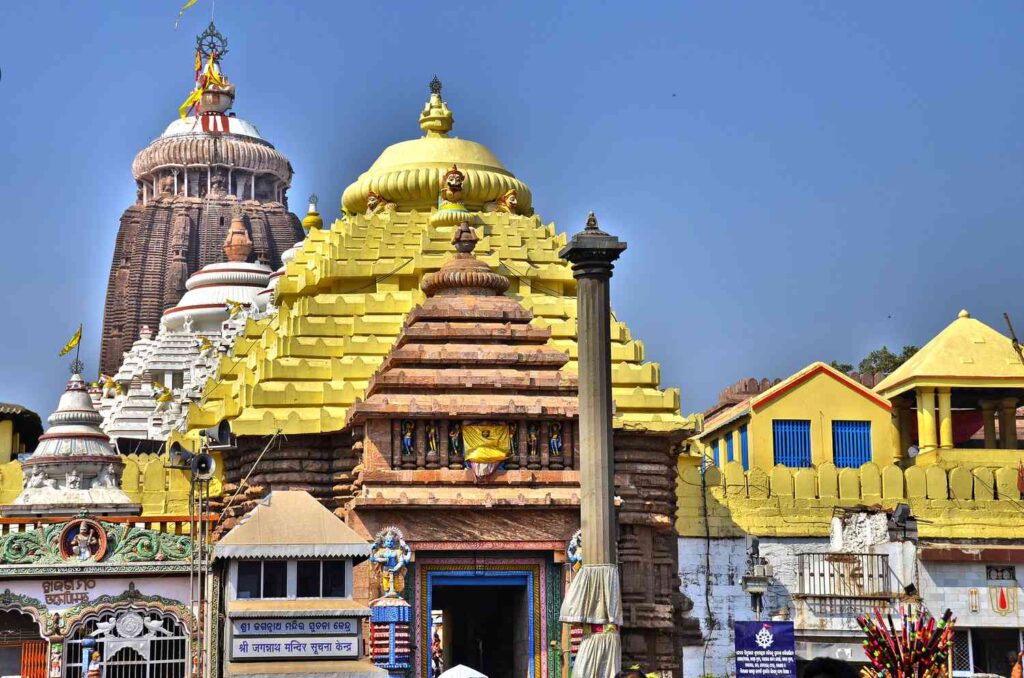
The four dhamas are: Badrinath (North — in the Himalayas), Puri (East — on the Bay of Bengal), Rameshwaram (South — at the tip of the Indian subcontinent), and Dwarka (West — on the Arabian Sea). Together, they form a sacred mandala of the entire subcontinent, inviting every devotee to traverse the land in a spirit of prayer and surrender.
Dwarka, as the western dham, carries the energy of endings and beginnings — the setting sun, the western horizon, the gateway between this world and the beyond. Pilgrims who complete the Char Dham Yatra are believed to have accumulated enormous merit (punya) and to have advanced significantly on the path to liberation (moksha).
One of the Sapta Puri — The Seven Sacred Cities
Dwarka also holds a distinguished place among the Sapta Puri — the seven holiest cities of India — whose mere remembrance, it is said, destroys sin and leads to liberation. The seven cities are: Ayodhya (birthplace of Lord Ram), Mathura (birthplace of Lord Krishna), Haridwar, Kashi (Varanasi), Kanchi, Ujjain (Avantika), and Dwarka.
"Ayodhya Mathura Maya Kashi Kanchi Avantika, Puri Dwaraka chaiva saptaita Mokshadayikah" — The seven cities that grant liberation
To visit all seven, or even to recite their names with devotion, is considered an act of profound spiritual merit. Dwarka's inclusion in both the Char Dham and the Sapta Puri speaks to its incomparable sanctity in the Hindu spiritual universe.
Sacred Temples of Dwarka: Stones That Sing of Krishna
1. Dwarkadhish Temple (Jagat Mandir) — The Crown Jewel
The Dwarkadhish Temple — also known as Jagat Mandir (Temple of the Universe) — is the spiritual heart of Dwarka and one of the most magnificent temples in India. This five-storey limestone structure, crowned by a 51.8-meter shikhara (spire) and draped with a massive flag bearing the sun and moon symbols, stands as a testament to both divine devotion and architectural mastery.
The temple is dedicated to Lord Dwarkadhish — Krishna as the King of Dwarka — in his four-armed form, holding a conch (Shankha), discus (Chakra), mace (Gada), and lotus (Padma). The presiding deity is believed to be a self-manifested (swayambhu) icon of great antiquity.
The temple complex has 72 pillars supporting the main hall and five domes, and the entire structure is built in the Chalukya style of architecture. The main entrance is the Moksha Dwar (Gate of Liberation) to the north, and the Swarg Dwar (Gate of Heaven) to the south. Devotees traditionally enter through Swarg Dwar and exit through Moksha Dwar — symbolizing the soul's journey through life toward liberation.
The flagpole atop the temple is changed three times a day with a new flag bearing the sun and moon emblems — signifying that as long as the sun and moon exist, Lord Krishna's sovereignty endures. Watching this flag change ceremony against the backdrop of the evening sky is a deeply moving spiritual experience.
2. Rukmini Devi Temple
Located approximately 2 km from the main Dwarkadhish Temple, the Rukmini Devi Temple enshrines Rukmini — the principal queen of Lord Krishna and a manifestation of Goddess Lakshmi. This exquisite 12th-century temple is a masterpiece of craftsmanship, with its walls adorned by intricate figurines narrating the stories of Rukmini's life.
The story behind the temple's location is itself a piece of divine lore: it is said that the sage Durvasa once visited Krishna and Rukmini's palace. As they pulled his chariot, Rukmini, overcome by thirst, took a sip of water without first offering it to the sage. Durvasa, known for his fierce temper, cursed Rukmini — causing her to be separated from Krishna and her palace to be placed outside the city. Despite the separation, their love remained inseparable — mirroring the soul's relationship with the Divine.
3. Nageshwar Jyotirlinga Temple
A short distance from Dwarka lies one of the twelve Jyotirlingas (self-manifested lingams of Lord Shiva) — the Nageshwar Jyotirlinga Temple. Shiva here is worshipped as Nageshwara (Lord of Serpents), representing protection and fearlessness. This temple reinforces Dwarka's position as a multi-dimensional sacred center — a place where the divine energies of both Vishnu and Shiva are present and harmonized.
The Nageshwar legend involves the devotee Supriya, who, even while imprisoned by a demon, continued his devotion to Lord Shiva. Pleased by his unwavering faith, Shiva manifested here and destroyed the demon — establishing the principle that sincere devotion transcends all obstacles.
4. Bet Dwarka — Island of Krishna's Treasure
Bet Dwarka (also known as Shankhodhar) is a small island located about 30 km north of Dwarka, accessible by a short ferry ride across the Gulf of Kutch. According to tradition, Bet Dwarka was Krishna's personal residence — the island where he lived with his family while Dwarka served as his royal capital and administrative center.
The island is home to the Dwarkadhish Temple of Bet Dwarka, believed to be the actual site where Krishna's treasure house and the palace of Rukmini once stood. The deity here is said to be the original idol of Dwarkadhish, worshipped by Krishna's chief queen Rukmini herself.
Bet Dwarka also houses temples dedicated to Hanuman (Lord of Devotion), Kuldevi (ancestral goddess), and several other shrines. The ferry ride to the island at dawn or dusk, with the sun painting the waters golden and devotional songs filling the air, is an unforgettable spiritual experience.
5. Gomti Ghat — The Sacred River Confluence
The Gomti Ghat, where the sacred Gomti River meets the Arabian Sea, is one of the most important ritual sites in Dwarka. Pilgrims traditionally take a holy dip (snan) in the Gomti River before entering the Dwarkadhish Temple — a purification practice believed to cleanse the body and mind of accumulated karma.
The ghat is lined with smaller temples, dharmashalas (pilgrims' resting places), and sadhus (ascetics). In the early morning, when the sky is still dark and lamps float on the water, the ghat takes on an otherworldly quality — as if time has dissolved and Krishna himself might emerge from the river, flute in hand.
6. Siddhpur Shaktipeeth and Surrounding Temples
The broader Dwarka region is home to numerous smaller temples, shaktipeeths, and shrines that form part of the extended pilgrimage circuit. The Shankhodwar Temple, the Kalyanrai Temple, the Trivikrama Temple, and the Ambaji Mata shrine are all part of the sacred landscape that surrounds the main city.
Festivals of Dwarka: When the City Transforms into Heaven
Janmashtami — Krishna's Birthday
No festival in Dwarka matches the grandeur of Janmashtami — the celebration of Lord Krishna's birth on the eighth day (ashtami) of the dark fortnight of the month of Shravan (July–August). During this time, Dwarka becomes unrecognizable — lakhs of devotees pour in from every corner of the country, the temples are illuminated with thousands of lamps and flowers, and the air vibrates with the continuous chanting of Krishna's names.
At midnight — the auspicious moment of Krishna's birth — the Dwarkadhish Temple erupts in joyous celebration. The deity is bathed in panchamrita (five sacred substances — milk, curd, honey, ghee, and sugar), dressed in new royal robes, and adorned with fragrant flowers. Devotees weep with joy, sway in ecstasy, and sing bhajans through the night. To experience Janmashtami at Dwarka is to touch the very moment of divine incarnation.
Holi — The Festival of Divine Love
Holi, the festival of colors, holds special significance in Dwarka as it does in Mathura and Vrindavan. Here it is celebrated as a commemoration of Krishna's playful pastimes with the Gopis (cowherd maidens) — a mystical expression of the soul's joyful union with the Divine. The streets of Dwarka become rivers of color, laughter, and devotion.
Dussehra and Diwali
Both Dussehra (celebrating the victory of Rama over Ravana, and by extension, of dharma over adharma) and Diwali (the festival of lights, associated with the return of Lord Ram to Ayodhya and celebrated widely as Lakshmi Puja) are observed with great fervor in Dwarka. The temples are illuminated magnificently during Diwali, and the city's reflection in the ocean waters creates a scene of extraordinary beauty.
Dev Uthani Ekadashi
The Dev Uthani or Prabodhini Ekadashi — the day Lord Vishnu awakens from his four-month cosmic sleep (Chaturmas) — is one of the most auspicious days in Dwarka. Massive processions, lamp-lighting ceremonies, and night-long vigils mark this day as a time of supreme auspiciousness and new beginnings.
A Pilgrim's Guide to Dwarka: Practical Wisdom for the Sacred Journey
Best Time to Visit
The most auspicious and climatically pleasant time to visit Dwarka is between October and March, when temperatures are mild (15°C–30°C) and the sea is calm. The monsoon season (July–September), while spiritually charged, can make travel and outdoor activities challenging due to heavy rainfall and rough seas. Janmashtami (August) is ideal for those seeking to experience the festivals, despite the crowds.
How to Reach
✦ By Air: The nearest airport is at Jamnagar (approximately 137 km away) or Rajkot (approximately 220 km away). From there, taxis and buses are readily available to Dwarka.
✦ By Train: Dwarka has its own railway station, well connected to major cities like Ahmedabad, Mumbai, Jaipur, and Delhi. The Saurashtra Express and other trains offer direct connectivity.
✦ By Road: Well-maintained highways connect Dwarka to major Gujarat cities. Jamnagar is approximately 2.5 hours away. Private vehicles, state buses, and shared taxis are all available.
Pilgrimage Etiquette and Customs
✦ Dress modestly and conservatively — traditional Indian attire (dhoti, kurta, saree) is recommended and shows respect for the sacred space.
✦ Remove footwear before entering any temple premise and observe silence or maintain a devotional mindset within the sanctum.
✦ Mobile phones must often be kept outside the sanctum of the Dwarkadhish Temple — check the current rules before your visit.
✦ Leather items (belts, bags, shoes) are generally not permitted inside temple premises.
✦ Rise early to attend the Mangala Aarti (pre-dawn prayer) at the Dwarkadhish Temple — one of the most spiritually powerful experiences Dwarka offers.
✦ Take a holy dip at Gomti Ghat before visiting the main temple. This traditional purification practice deepens the pilgrim's inner receptivity.
Key Pilgrim Experiences Not to Miss
✦ Mangala Aarti at Dwarkadhish Temple: The pre-dawn prayer ceremony, held before sunrise, is an experience of unparalleled devotional intensity. The conch blows, the bells ring, and the curtain parts to reveal the deity in the darkness — lit only by the glow of lamps.
✦ Sunset at Gomti Ghat: As the sun sets over the Arabian Sea and lamps are lit at the ghat, the atmosphere becomes suffused with a golden, timeless quality that touches even the skeptical heart.
✦ Ferry to Bet Dwarka: The journey across the water to the island and the darshan (sacred viewing) of the deity there is a quieter, more intimate experience than the main temple.
✦ Pradakshina (Circumambulation) of the Dwarkadhish Temple: Walking around the temple clockwise while chanting the divine names of Krishna is a deeply meditative practice.
✦ Evening Aarti: The sunset aarti at the main temple, when the oil lamps are waved before the magnificently adorned deity, is a moment when the boundary between the devotee and the Divine seems to dissolve.
The Deeper Teaching: What Dwarka Reveals About the Soul
Beyond its geographical and historical dimensions, Dwarka is a profound spiritual symbol. The mystical traditions of Sanatan Dharma invite us to interpret the outer world as a mirror of the inner — and Dwarka, seen in this light, reveals deep truths about the human soul's relationship with the Divine.
The City Within — Dwarka as the Heart
Many saints and sages have interpreted Dwarka as a symbol of the human heart purified by devotion. Just as Vishwakarma built the outer Dwarka at Krishna's command, it is through the practice of sadhana (spiritual discipline), bhakti (devotion), satsang (holy company), and seva (selfless service) that we build the inner Dwarka — a purified heart-space where the Lord can reside.
The eight gates of mythological Dwarka represent the eight petals of the heart chakra (Anahata) — and Krishna's entry into this inner city is the experience of divine grace that the devotee seeks through a lifetime of practice.
The Submerged City and the Hidden Divine
The fact that the historical Dwarka now lies beneath the sea carries a beautiful philosophical teaching: the Divine is not always visible to the outer eye. Like the submerged city, the presence of God in our lives often lies beneath the surface of ordinary perception — awaiting the sincere diver of the soul who is willing to plunge beneath the waves of ego, desire, and distraction to find the golden city within.
Krishna's Departure and the Teaching of Impermanence
The story of Dwarka's submergence after Krishna's departure is one of the most profound teachings in all of Hindu philosophy: nothing in the phenomenal world lasts. Even the most perfect and divine city — built by Vishwakarma himself — must yield to the ocean when its time is complete. This is not a tragedy; it is a teacher. It reminds us that our attachments to the outer world — to wealth, position, and even beloved relationships — must ultimately be loosened in favor of the eternal relationship with the Divine.
And yet — though Dwarka the city submerged, Dwarka the sacred site endures. Though Krishna departed in his physical form, his presence suffuses every stone, every wave, every sunset over the Arabian Sea. This teaches us the other half of the truth: while forms are temporary, consciousness — divine consciousness — is eternal and indestructible.
Dwarka and Modern Archaeology: Faith Confirmed by Discovery
The intersection of faith and archaeology at Dwarka is one of the most fascinating stories in the history of human civilization. For centuries, the narrative of Krishna's city being swallowed by the sea was considered by rationalists to be myth. The discoveries of the 20th and 21st centuries have significantly challenged that dismissal.
Dr. S. R. Rao and his team from the Archaeological Survey of India conducted systematic underwater excavations at Dwarka between 1983 and 2001. They discovered:
✦ Stone walls and structures at a depth of 5-12 meters below sea level
✦ Triangular and trapezoidal stone anchors consistent with those used in the Harappan and Late Bronze Age periods
✦ Pottery shards, seals, and artifacts that corroborate occupation during the period of 1500–1000 BCE
✦ A city layout consistent with descriptions in ancient texts — a grid pattern with well-defined streets and public areas
While scientific debates continue about the precise dating and interpretation of these findings, the existence of a sophisticated ancient city beneath the waters at Dwarka is no longer seriously disputed. The faithfully preserved ancient texts described something real — and the ocean, it seems, preserved the evidence.
For spiritual seekers, this convergence is deeply affirming. The Bhagavata Purana, the Mahabharata, and the Vishnu Purana — all describing the magnificent city of Dwarka — were not merely composing poetry. They were recording history from a different angle of vision.
The Experience of Dwarka: Voices Across Time
Across centuries, poets, saints, philosophers, and ordinary devotees have left behind testimonies of the transformative power of Dwarka. The Alvars — the twelve great Vaishnava poet-saints of South India — composed ecstatic hymns about Dwarka. Adi Shankaracharya established his western Matha (monastery) at Dwarka, recognizing its supreme spiritual potency. The medieval saint-poet Mirabai, on her pilgrimage to Dwarka, is said to have merged into the deity in an act of supreme devotion.
Narsi Mehta — Gujarat's beloved devotee-poet and author of the iconic bhajan 'Vaishnava Jana To' (beloved by Mahatma Gandhi) — was deeply connected to the Dwarka tradition. His life and songs reflect the essence of what Dwarka represents: a heart open to the Divine, a life lived in loving service, and the complete surrender that transforms even the humblest person into a vessel of grace.
"To see Dwarka once, to stand at Gomti Ghat as the sun rises over the ocean, to hear the conch of the Dwarkadhish Temple — this is to know, without argument or doubt, that God is real and love is the only truth." — A Pilgrim's Journal
Sacred Mantras and Prayers Associated with Dwarka
The Dwarkadhish Ashtakam
Many ancient Sanskrit texts contain specific prayers for the presiding deity of Dwarka. The following is a verse from the Dwarkadhish Stotra:
"Mangalam Dwaraka Nagari, Mangalam Mathura Puri Mangalam Gokulam Dhama, Mangalam Vrindavanam Vanam Mangalam Gopika Krishna, Mangalam Yamuna Jalam Mangalam Sarvam Sarvasya, Sri Krishna Sharanam Mama"
Translation: Auspicious is the city of Dwarka, auspicious is the holy Mathura; auspicious is the abode of Gokul, auspicious is the forest of Vrindavan. Auspicious are the Gopis and Krishna, auspicious are the waters of the Yamuna; may all things be auspicious — I take refuge in Sri Krishna.
The Dwarkadhish Mantra
"Om Namo Bhagavate Dwarkadhishaya Namah"
This mantra, dedicated to Lord Dwarkadhish, invokes the divine protection, grace, and blessings of Lord Krishna as the sovereign of Dwarka. Chanting this mantra 108 times daily is believed to dissolve obstacles, purify the mind, and align the devotee with divine will.
The Shodasha Nama Stotra (Sixteen Names of Dwarka)
A beloved tradition at Dwarka is the recitation of the sixteen names of the city — each name revealing a different facet of its divine personality. Reciting these names with devotion is believed to bestow the merit of visiting Dwarka even upon those who cannot physically travel there.
A Final Reflection: Why Dwarka Still Calls
In an age where ancient traditions are often dismissed as superstition and the inner life of human beings is colonized by the noise of the digital world, Dwarka stands as a powerful counter-presence. It calls — as it has called for thousands of years — to the part of every human being that knows there is more to life than what the eyes can see.
Dwarka calls to the devotee who longs for a glimpse of the Lord. It calls to the philosopher who senses that history and mythology are not opposites but different languages for the same truth. It calls to the scientist who stands before the submerged city walls in wonder. It calls to the artist who sees, in the golden spire of the Dwarkadhish Temple against the evening sky, a beauty that transcends the merely aesthetic.
Most of all, Dwarka calls to the soul — that part of us which has always known itself to be not a body in the world, but a consciousness in the presence of the Infinite. To visit Dwarka, even once, is to answer that call. And to answer it is to begin — or deepen — the greatest journey any human being can make: the journey home to the Divine.
"Blessed is the one who takes the name of Dwarka with love in their heart. Blessed is the one whose feet touch its sacred soil. And most blessed of all is the one who finds, in the city of the Lord, the city of their own awakened soul."
🙏 Jai Dwarkadhish 🙏
Hare Krishna Hare Krishna, Krishna Krishna Hare Hare | Hare Rama Hare Rama, Rama Rama Hare Hare
© ridhyaspiritual.com | Serving the Divine with Devotion
Converted to HTML with WordToHTML.net | Document Converter for Windows